Crypt Gallery 2024

I concentrated on three areas of mathematical knots in this exhibition. Knots, of course, Continuous deformation and Braids. As you scroll through the images there will be brief explanations.
KNOTS
Take a strand of string, loop and weave it around itself as many times as you will and then join its ends. There you have a mathematical knot. The study of what lies inside this simple object is called Knot theory and has far reaching applications in mathematics, quantum physics, fluid dynamics and genetics.
They are categorised by the number of times the string crosses itself.

Big knot, 11_34
The Conway knot as a ribbon.
Black and white Pastel
There are 552 knots with 11 crossings. This knot is the 34th.

Smooth Slice, a counter offering.
The black swirls and curves are taken from the solution to the long standing problem in knot theory. Lisa Piccirillo, an american mathematician solved the problem, finding that knot 11_34, the Conway knot, was not smooth slice. (Don’t ask!!) I emailed her and asked if we might meet on zoom sometime to talk about her work. I did not hear back from her. So I decided to have a bit of fun. I inserted a smooth slice into her solution. My slice is in no way mathematical, it is purely humorous.
Pastel, pencil and siberian charcoal

Two studies for Smooth Slice Pencil and pastel
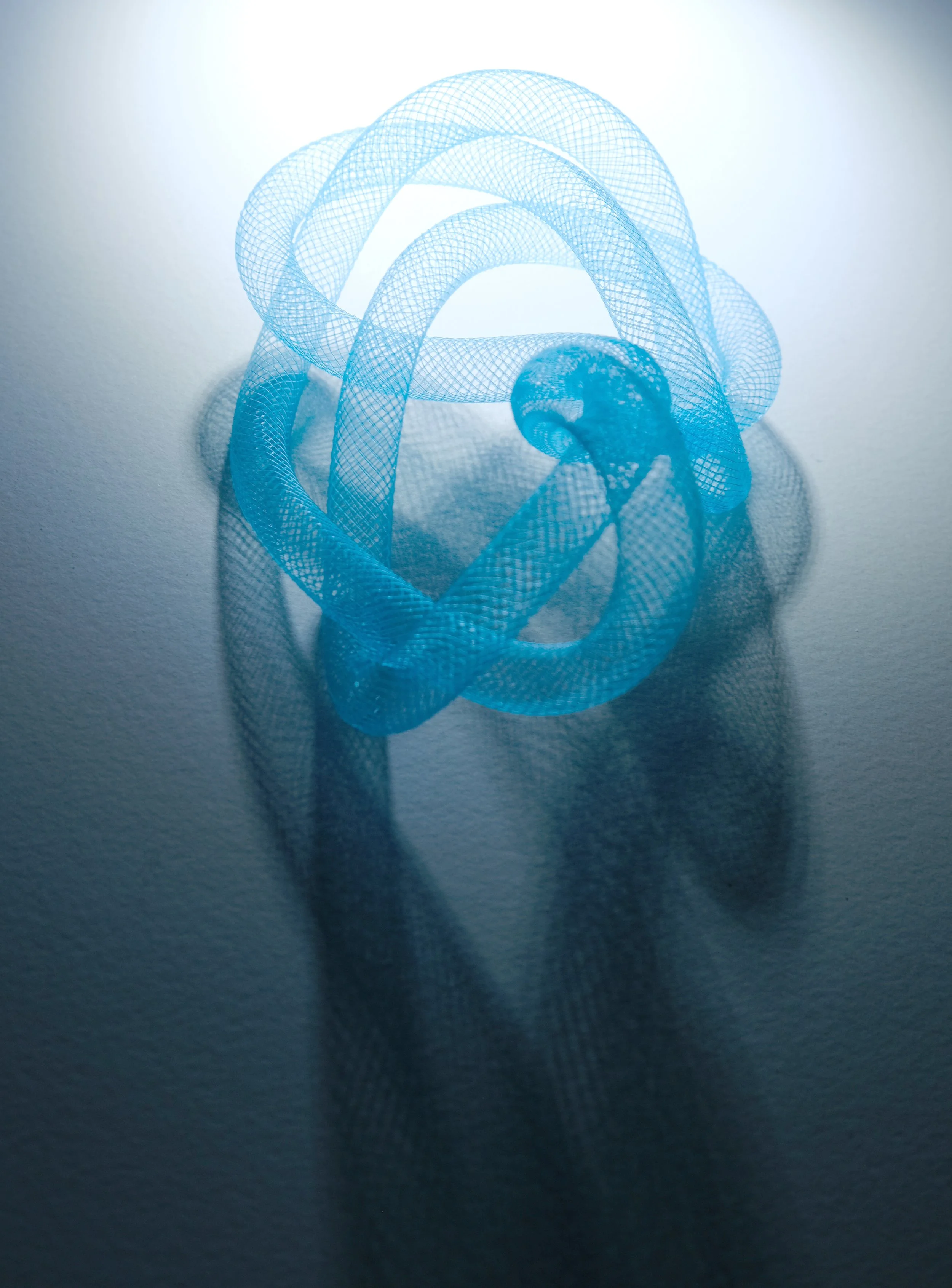
Blue Knot 10-15
Giclee print

Three Knots
7_3, 8_4 and 9_24
Pencil


8-6 Emerging
This is a plaque 30cm by 20cm by 8cm. It is a 3D version of knot 8_6 in the Three Knots drawing above.


Zero, Three, Four.
Pencil
Five, Six, Seven
Pencil
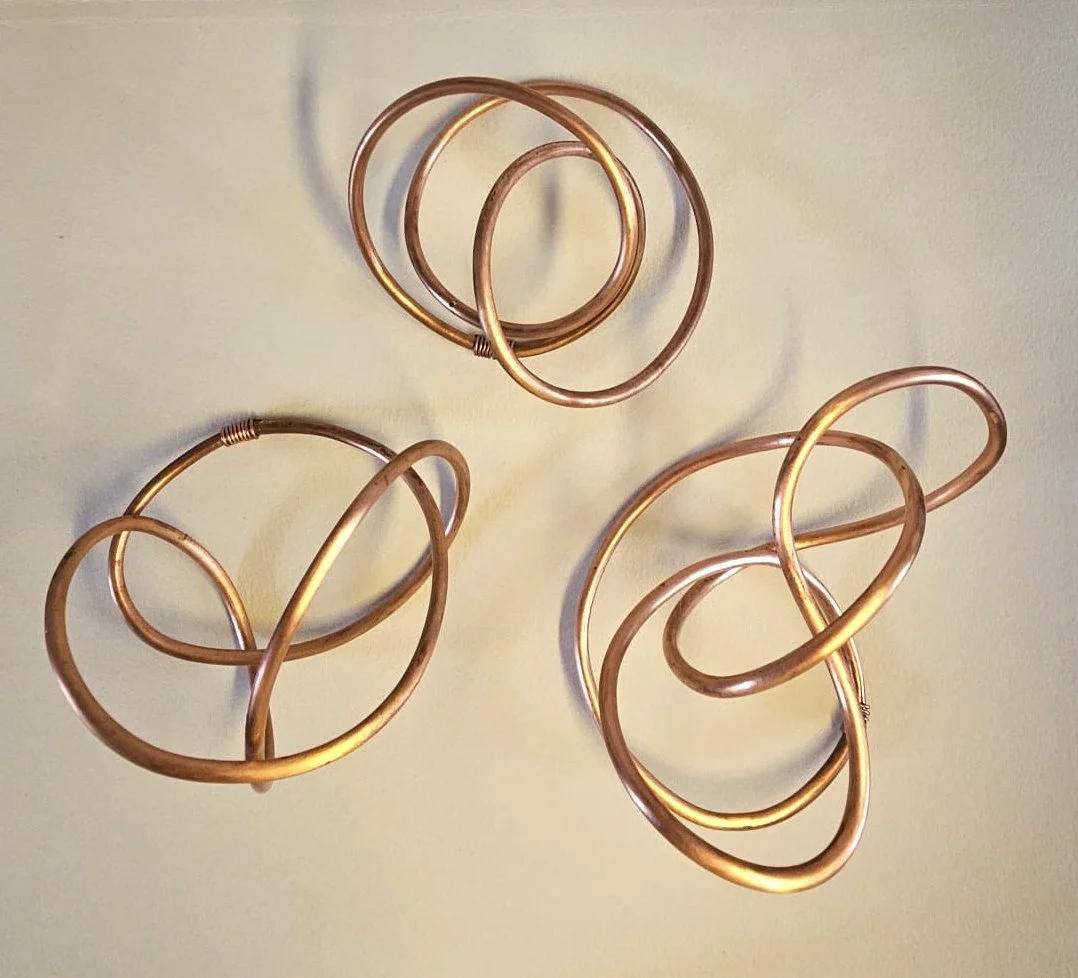
Copper Knots
3_1, 4_1, 5_2
These knots are made from 3mm copper bar
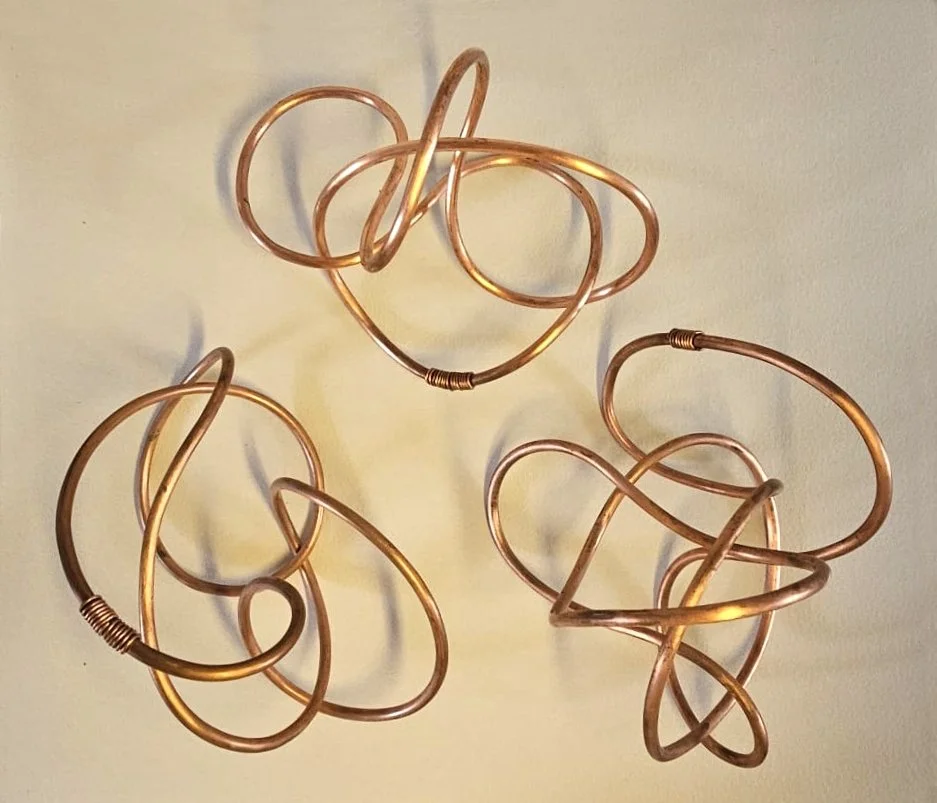
Copper Knots
6_1, 7_4, 8_10

White 5-2 knot
Giclee print

Knot 5_2
Suspended on an Idea.
Pencil

Mystery Knot
Giclee print

BRAIDS

Braids are knots that are flattened and arranged into 2D diagrams that show how the knot strand crosses over and under itself.
This is the braid of 3 conjoined knots

On Point
The dancing braid of knot 10_54

Copper Braid of the Conway Knot 11_n 34
3 mm copper bar mounted on wenge wood

Unfurling
The conjoined braid of knots 6_3, 7_6 and 8_6 opening and unfurling, returning to a knot form.
Pencil

Kind of Like a Quantum Computer
I drew this before I learned that quantum computers employ braiding through fine sheets of rare earth minerals to perform computations.
Pastel and coloured pencil

A doughnut and a coffee mug are the same thing to a topologist and a knot theorist. It is a well known example of continuous deformation. The one thing that doesn’t change as you deform the doughnut is its hole and the hole where your fingers go in the mug handle. It is about what cannot change as the surface is being deformed.
CONTINUOUS DEFORMATION

Reidemeister Moves
These are the three moves which allow for the continuous deformations that are at the centre of knot theory and its mathematical cousin, topology
Pencil

Curtain An imagined diaphanous curtain, depicting changes in surface of a two-twist spun trefoil knot diagram
Coloured pencil and pastel


Reidemeister Flowers
This is a decorative play on the Two Twist Spun Trefoil knot stacked diagram as a vase and the Reidemeister moves stretched and extended as colourful flowers.
Coloured pencil and pastel
Spun Trefoil Knot
The spinning trefoil knot sweeps out a surface which passes through and around itself.
Giclee Print

Spun 5_2 Knot
Giclee Print


Spun Mobius Band
Almost a Klein bottle as it moves through itself.
Giclee print
Two-Twist Spun Trefoil Knot Slices
This depicts slices of a knotted surface as it moves through itself. It is the work of the mathematicians listed in the drawing. My role in the piece was to lift it out of the diagram make it beautiful
Pencil