FROM DIAGRAM TO DISORDER
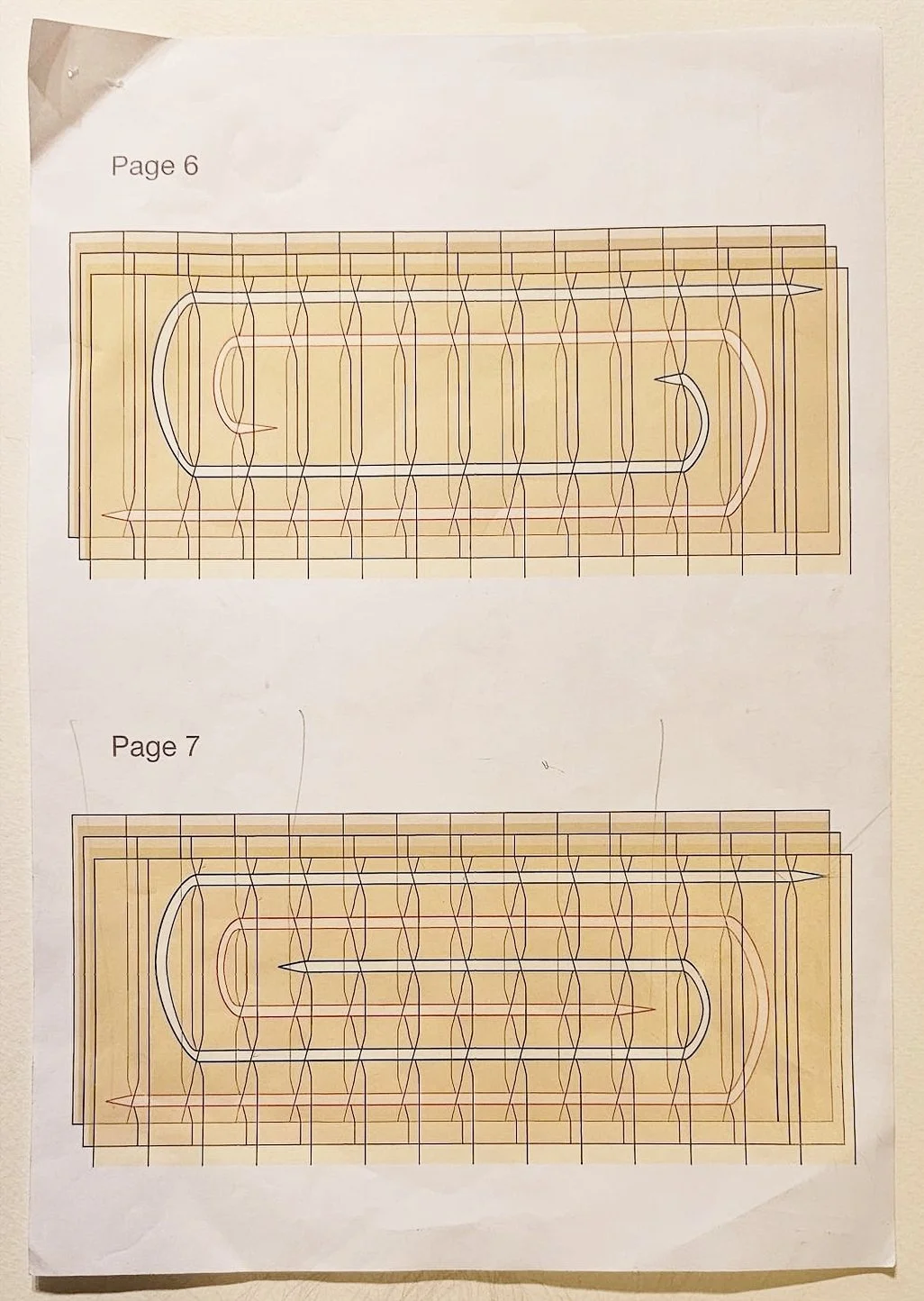
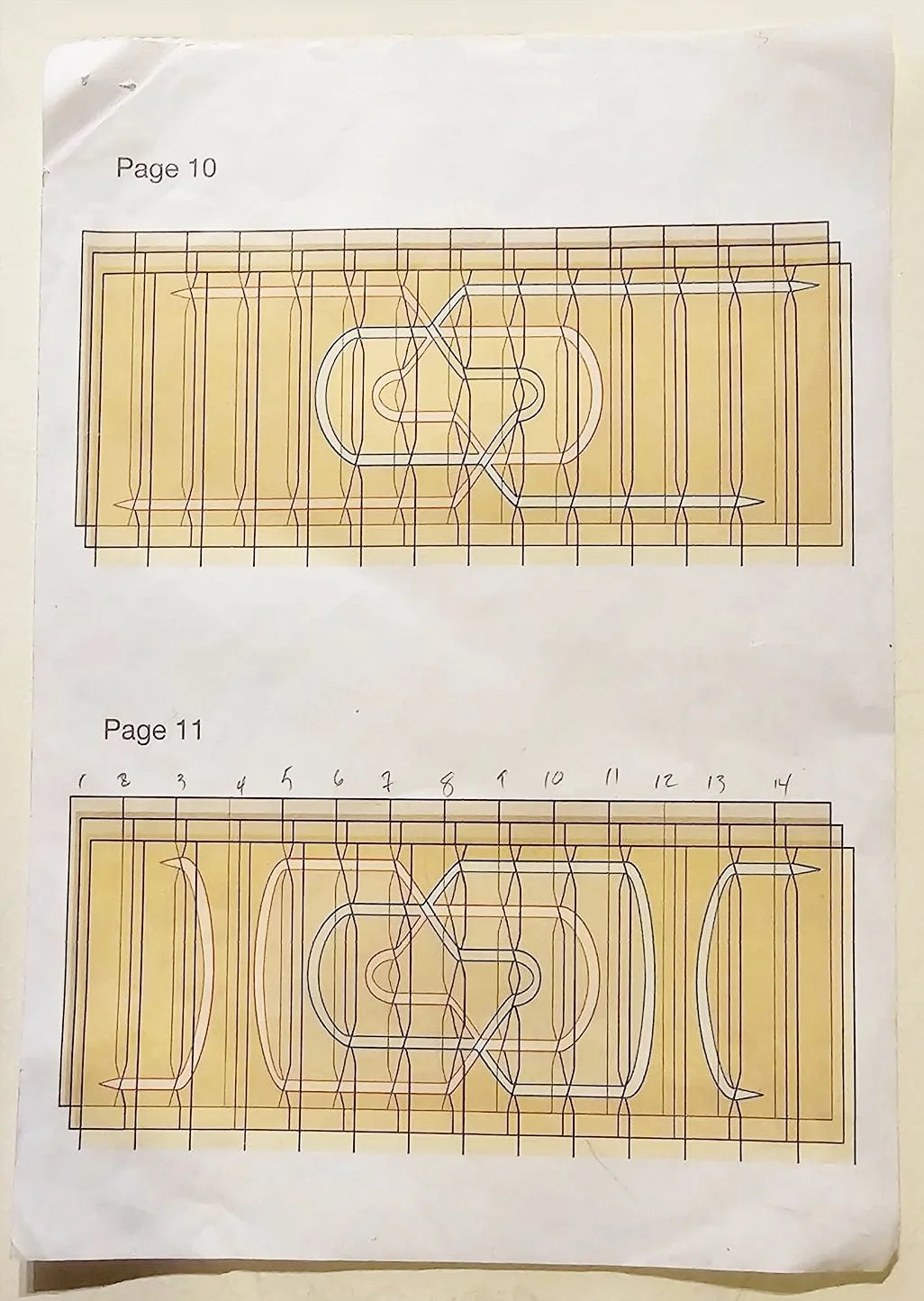
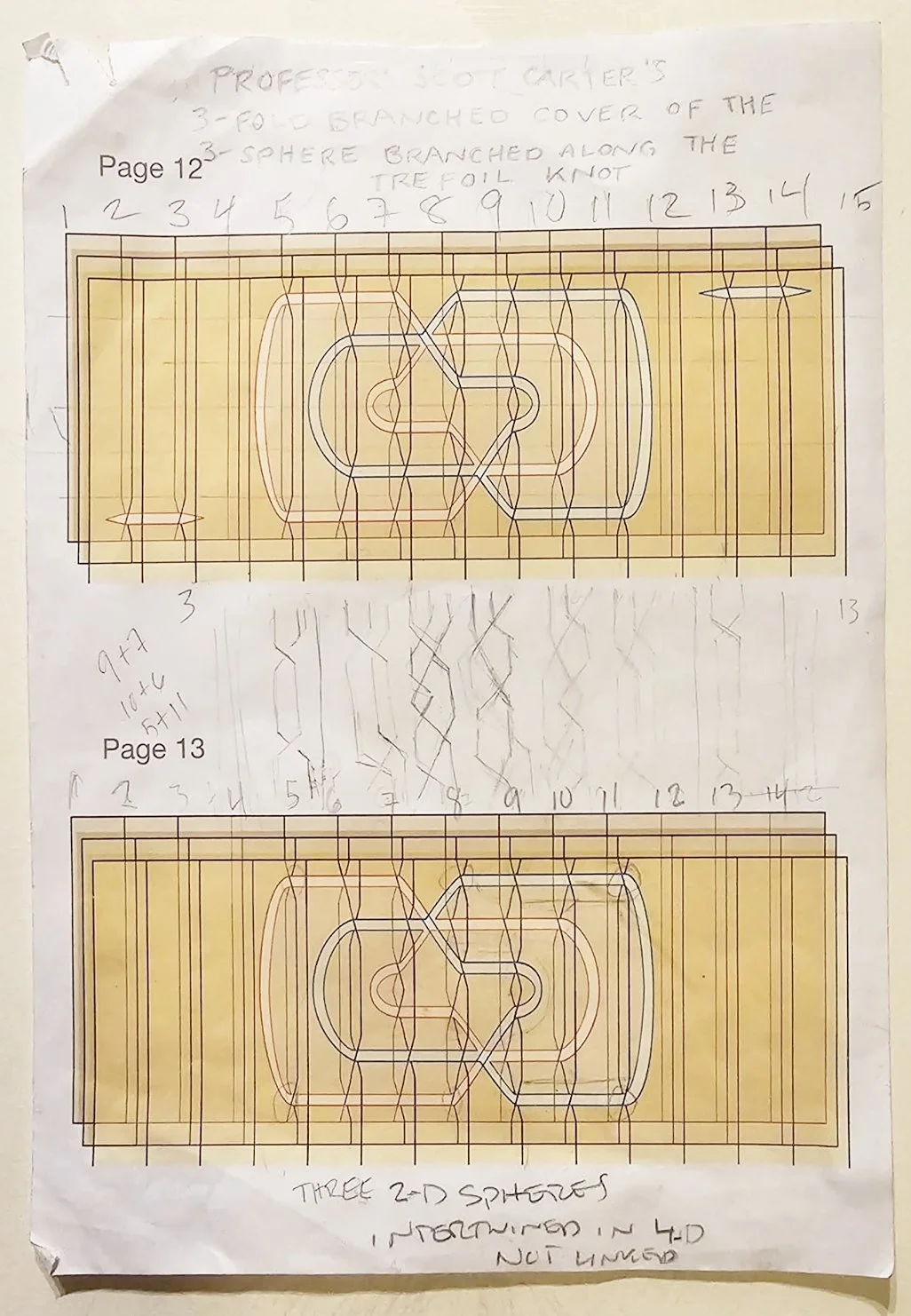
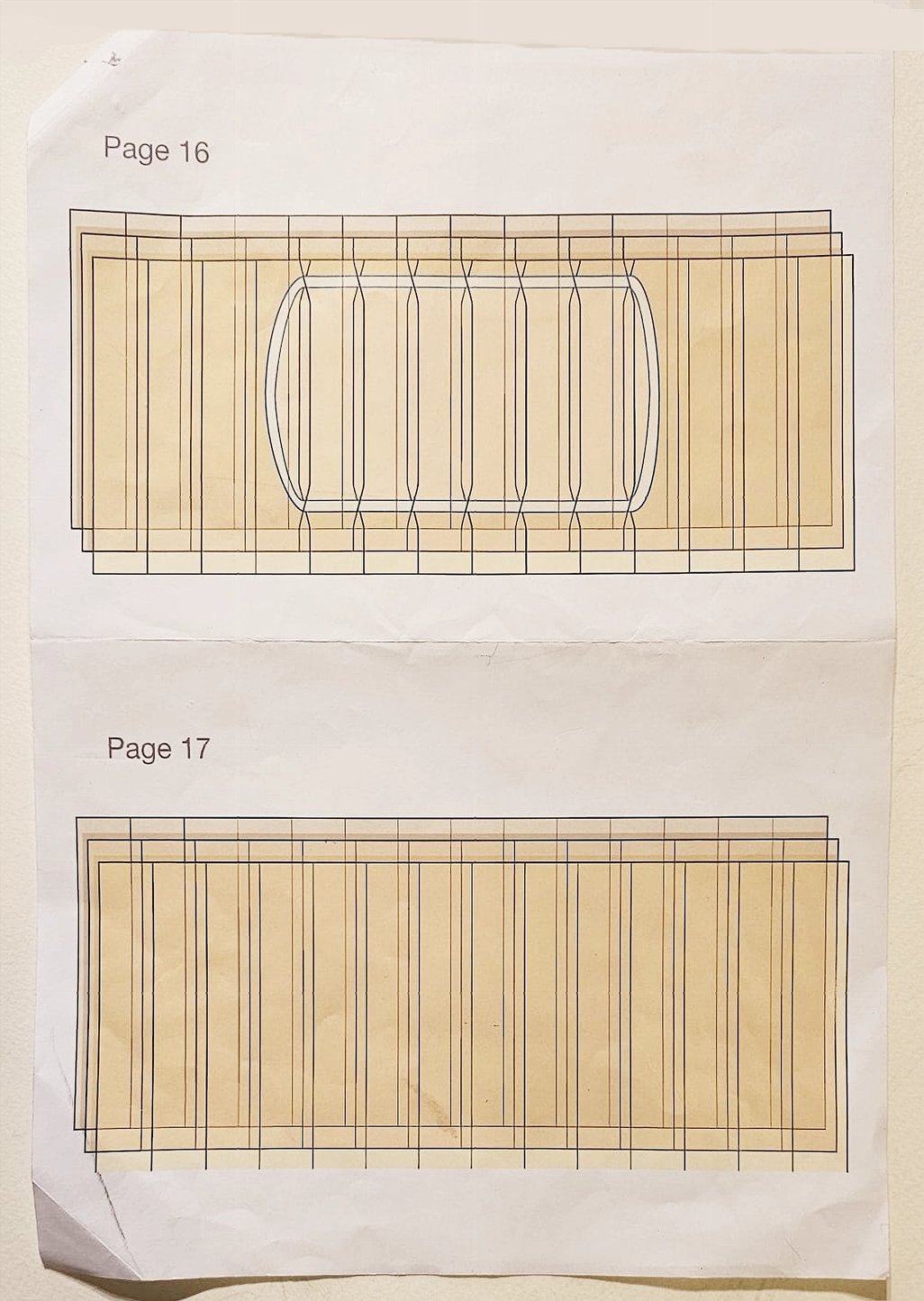
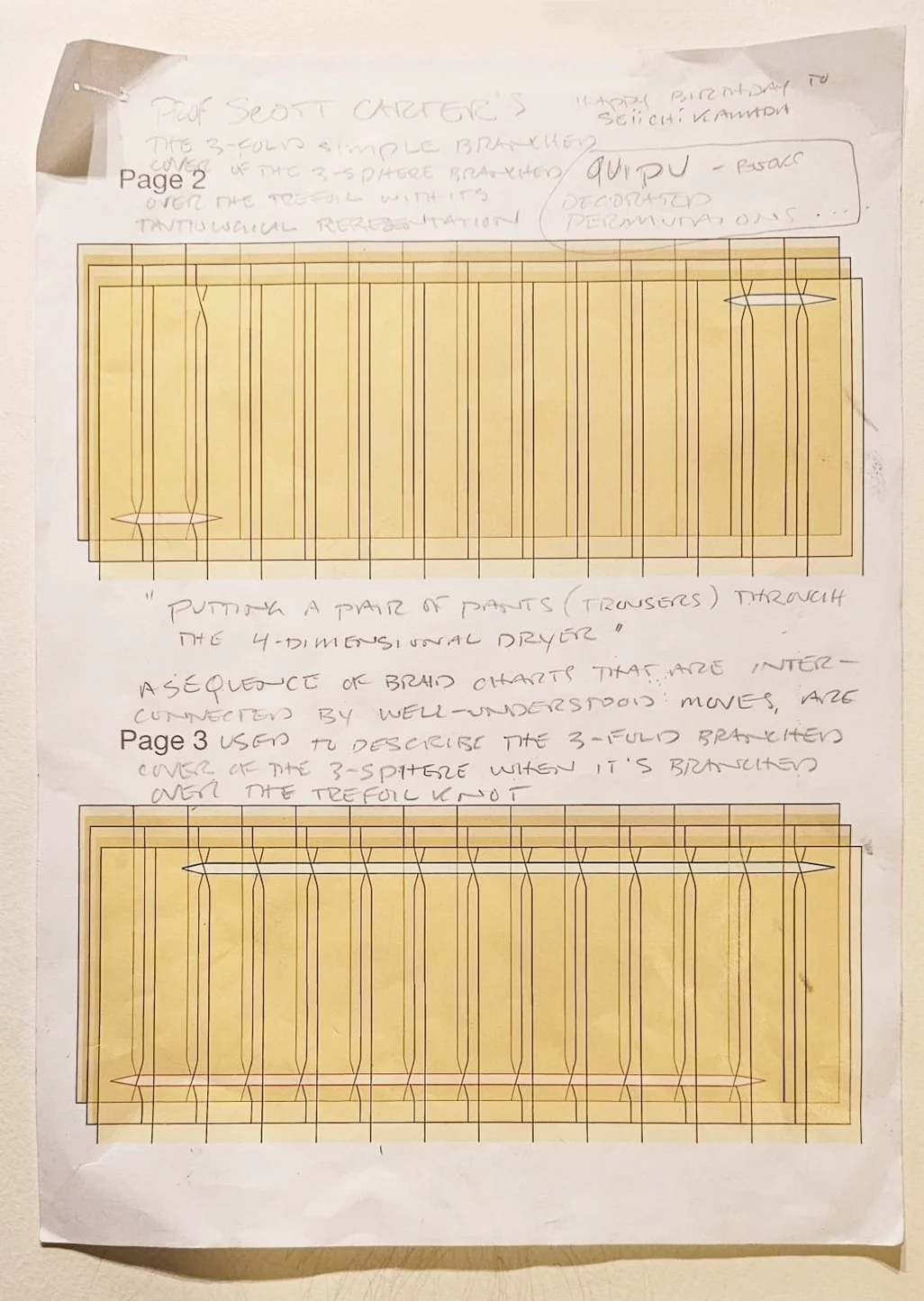
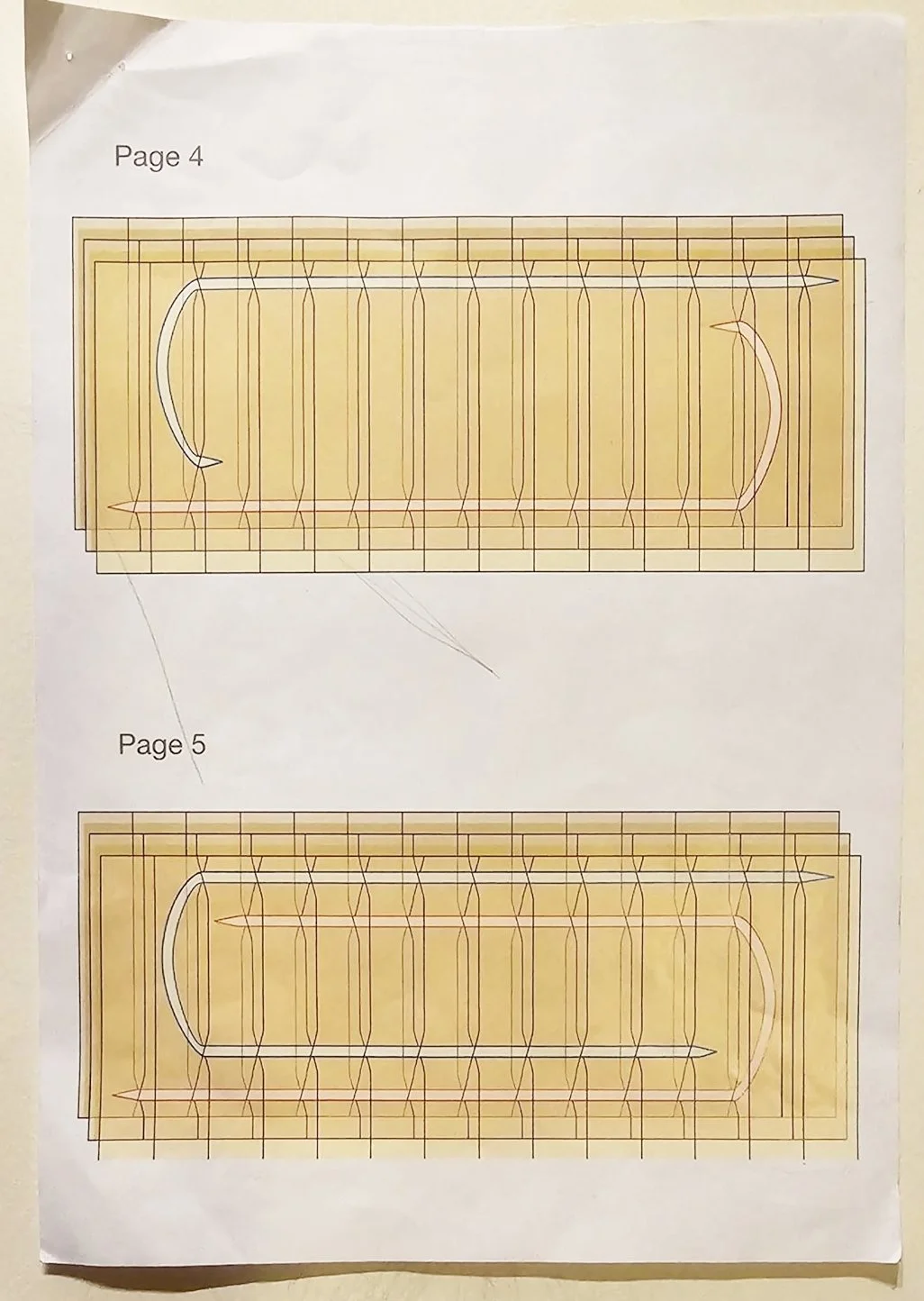
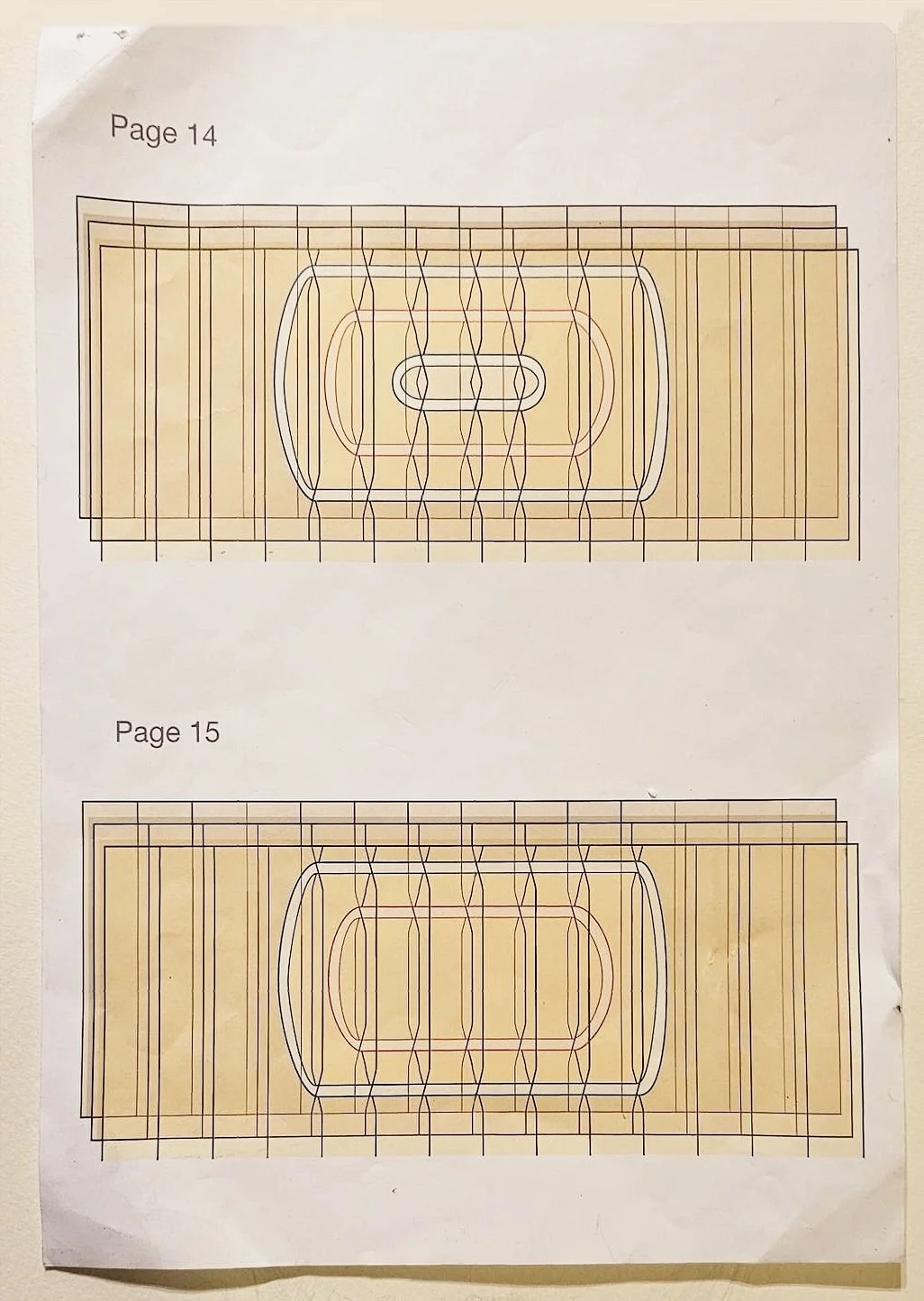
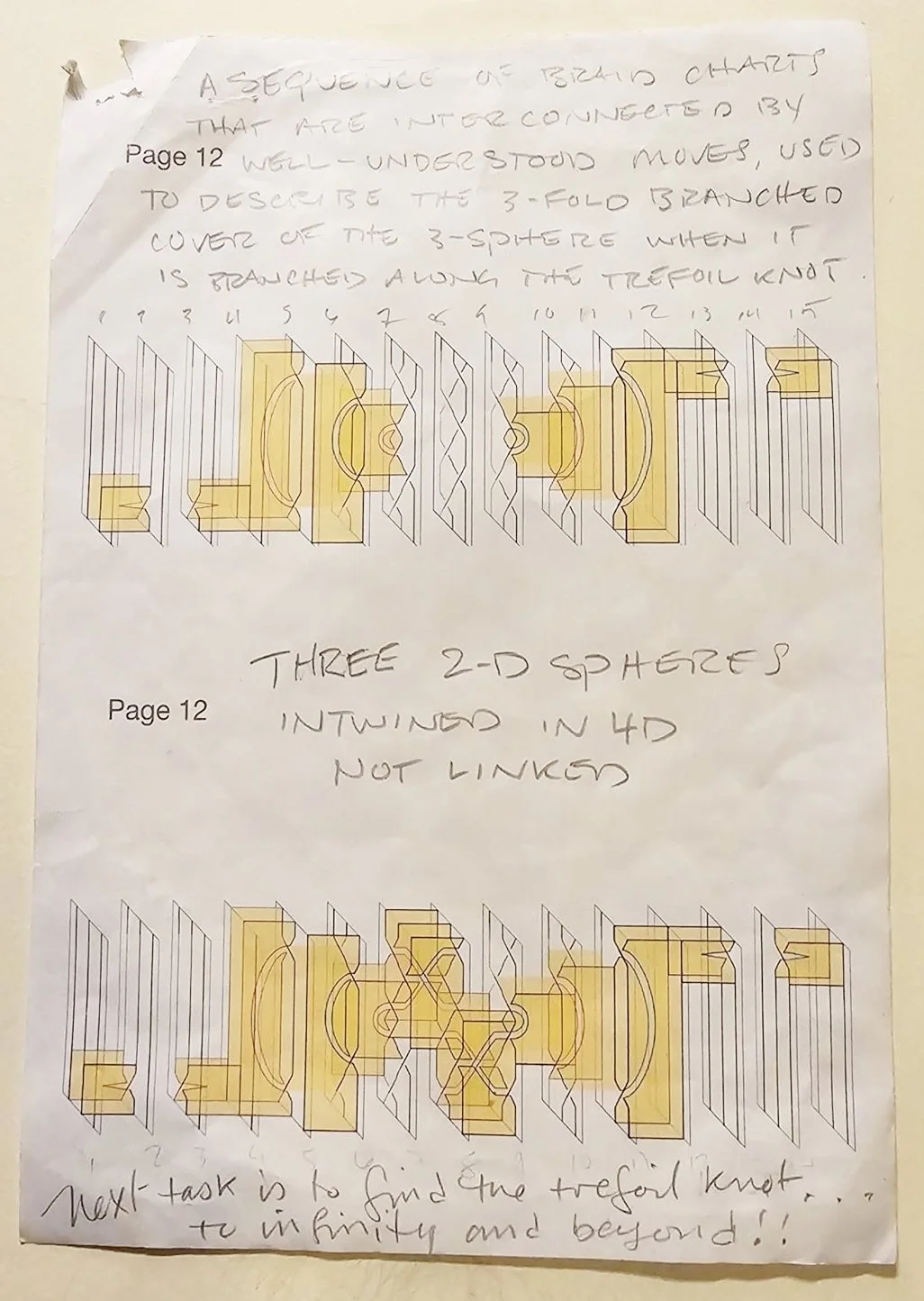
Professor Scott Carter’s diagrams of the 3-fold branched cover of the 3-sphere branched along a trefoil knot.
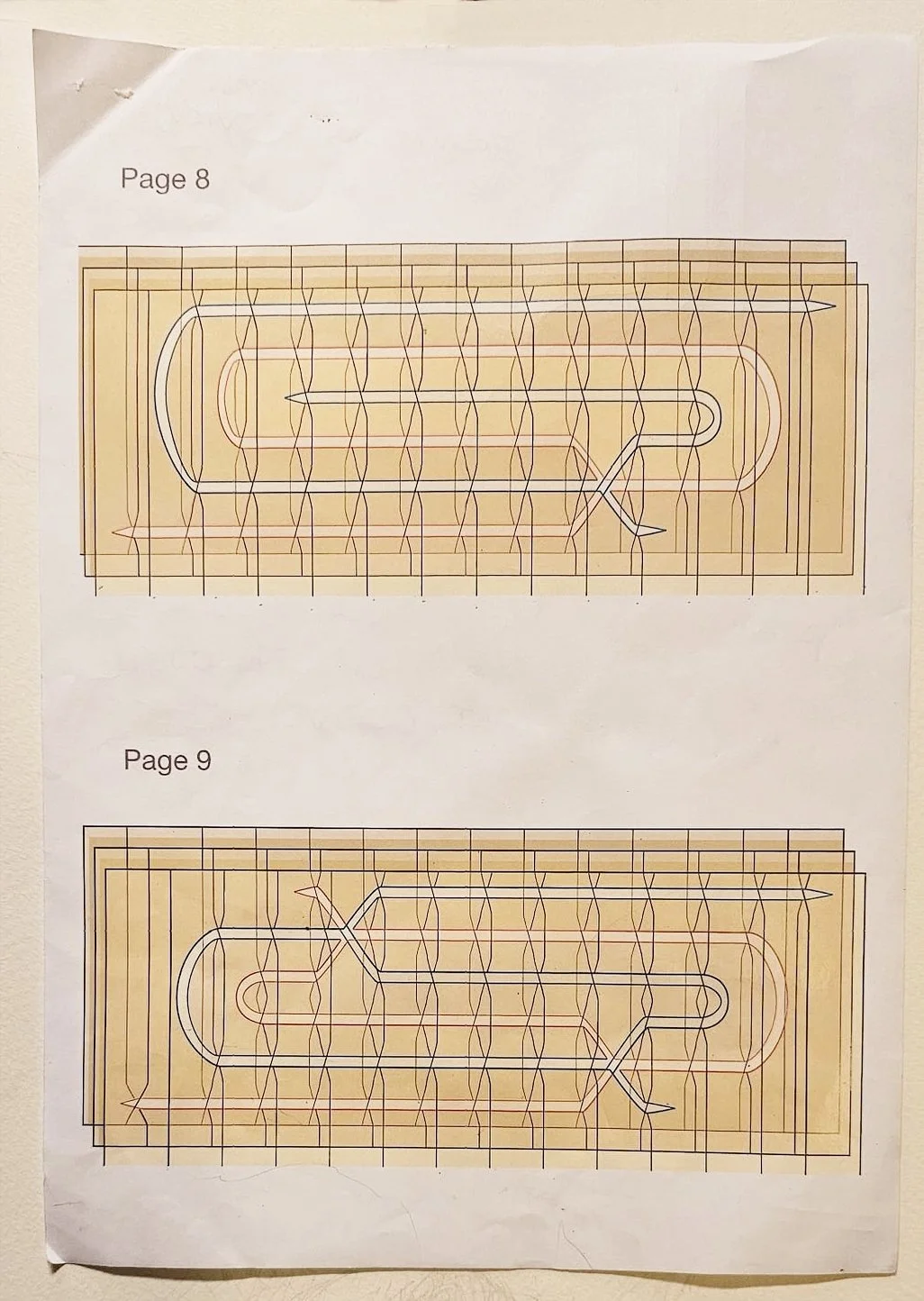
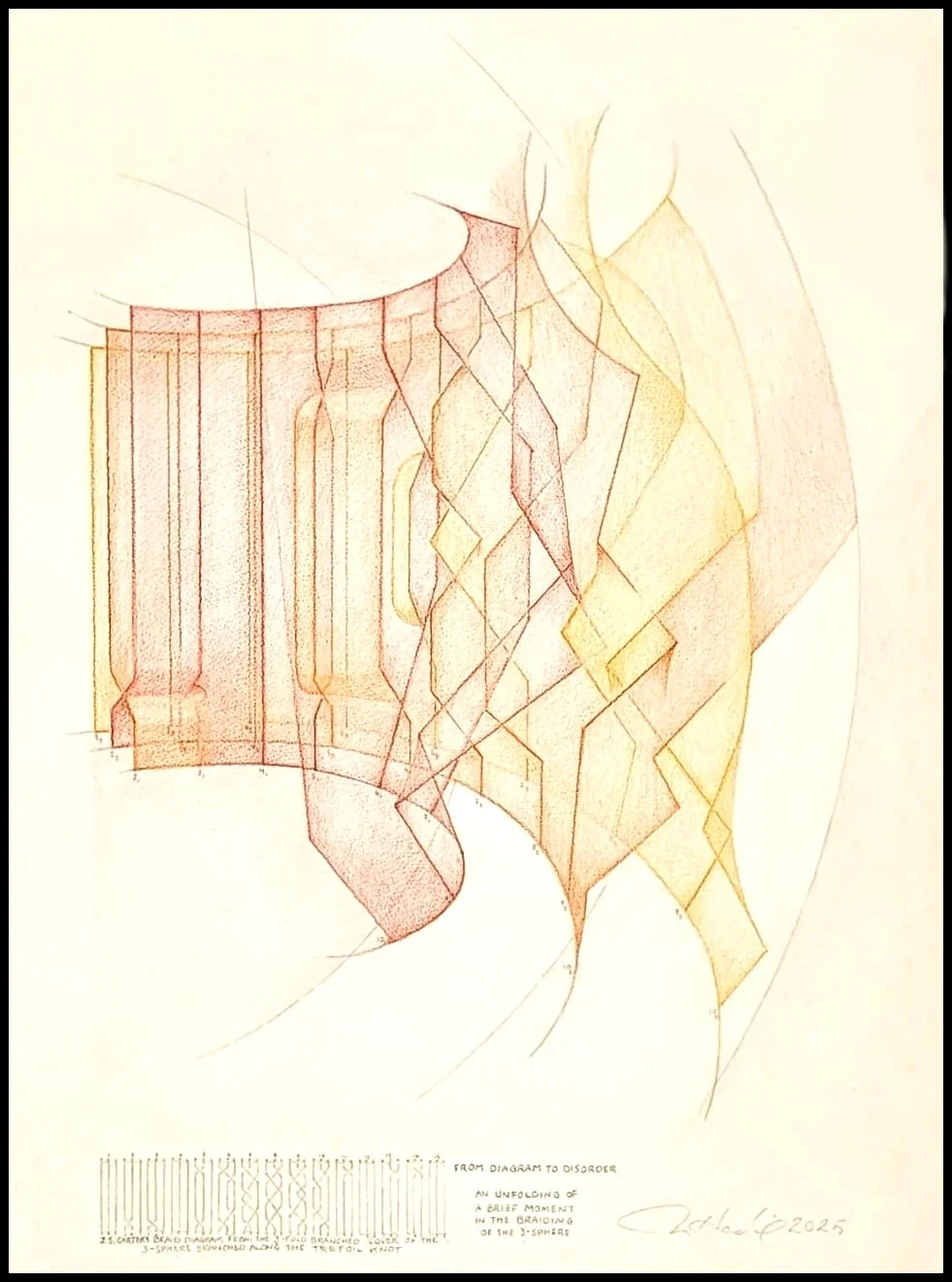
From Diagram to Disorder
An unfolding of a brief moment in the braiding of the 3-sphere
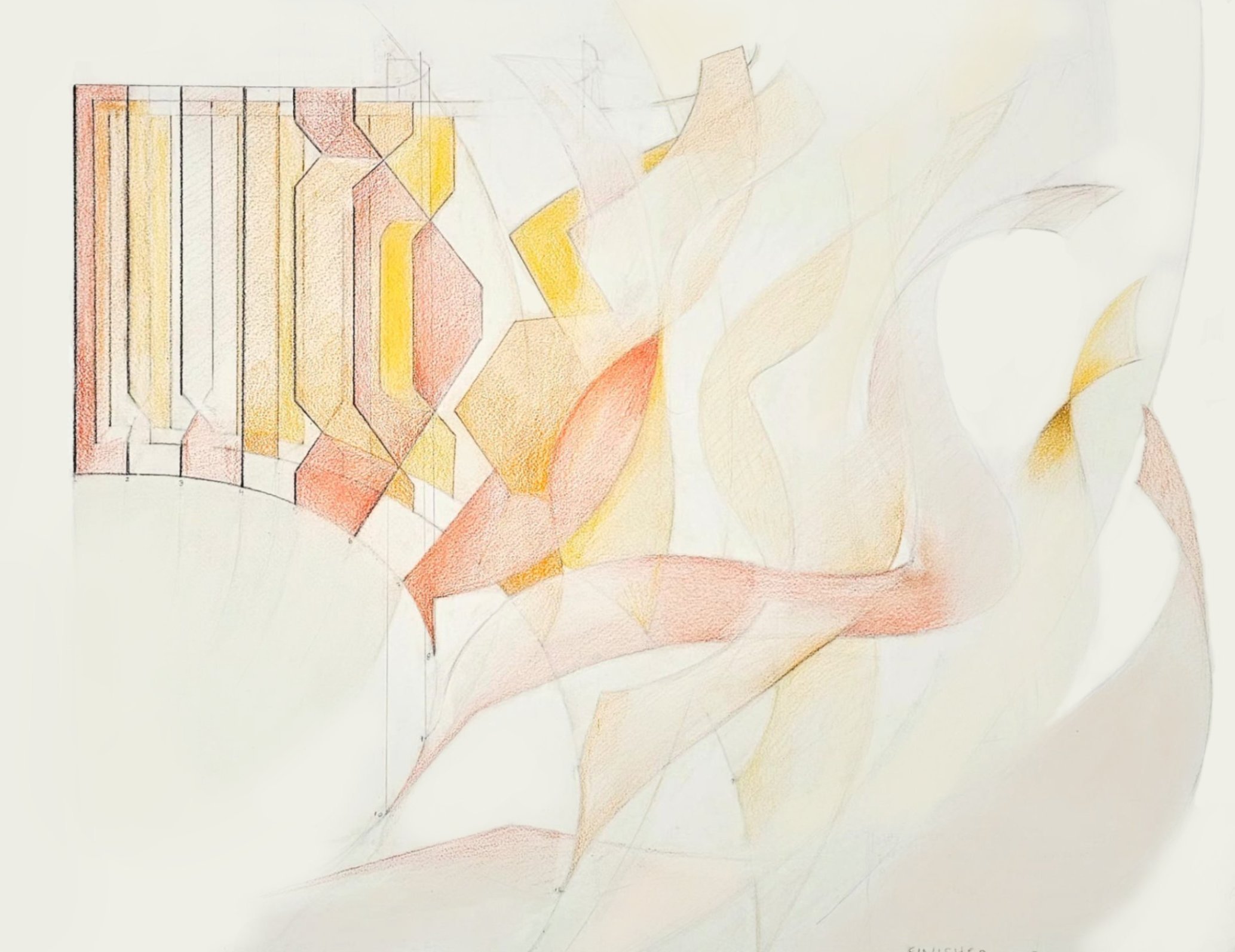
This gentle, coloured pencil drawing came out of ten months of drawing studies, several attempts at large interpretations and many long Zoom sessions with knot theorist Scott Carter. It is based on Scott’s and Saiichi Kamada’s 3-fold branched cover of the 3-sphere branched over the trefoil knot. Below is the story of its conception.
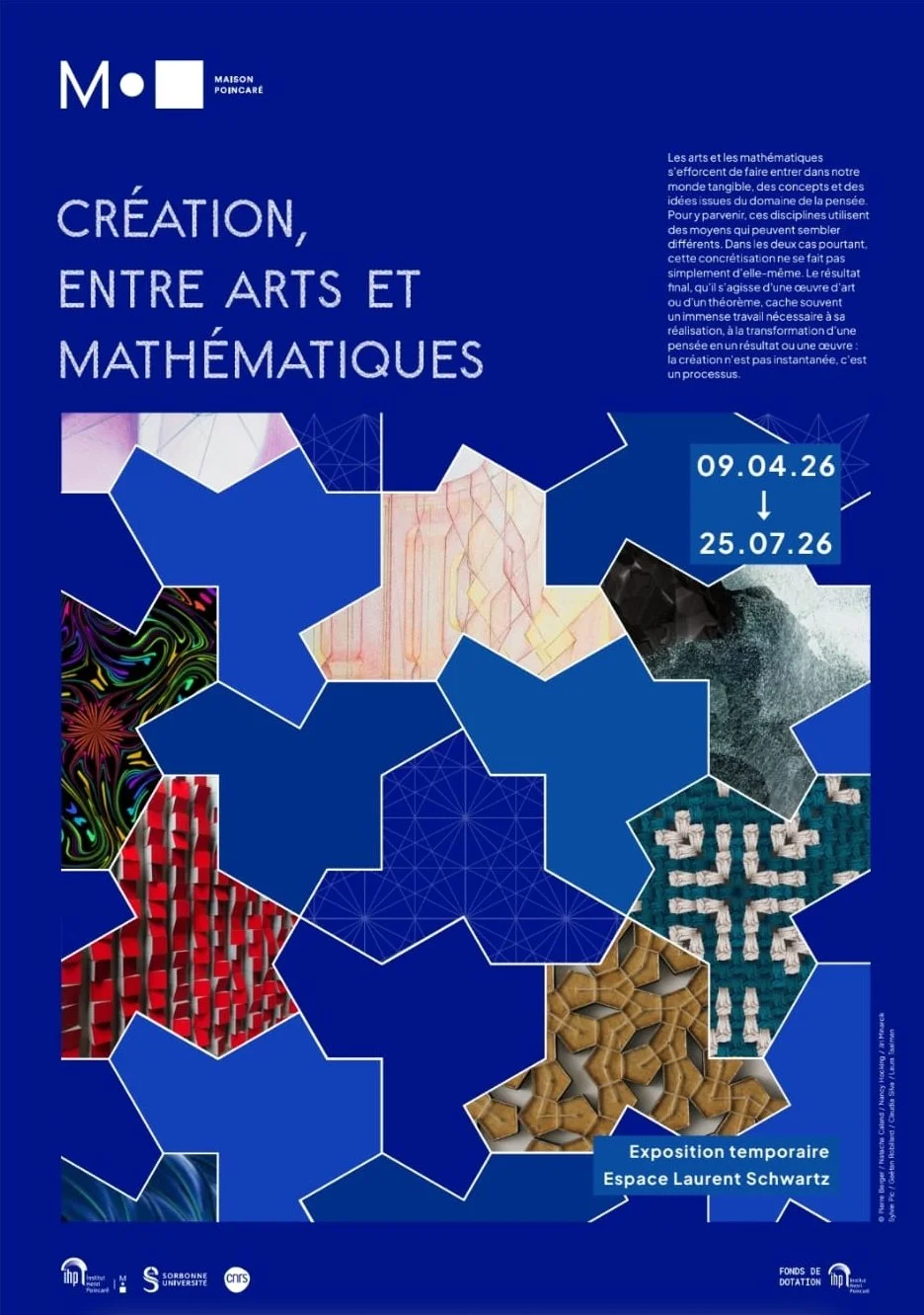
I am honoured to be taking part in this exhibition, Creation, entre Arts et Mathematiques, at the Institute Henri Poincare in Paris. It runs until 25 July 2026.
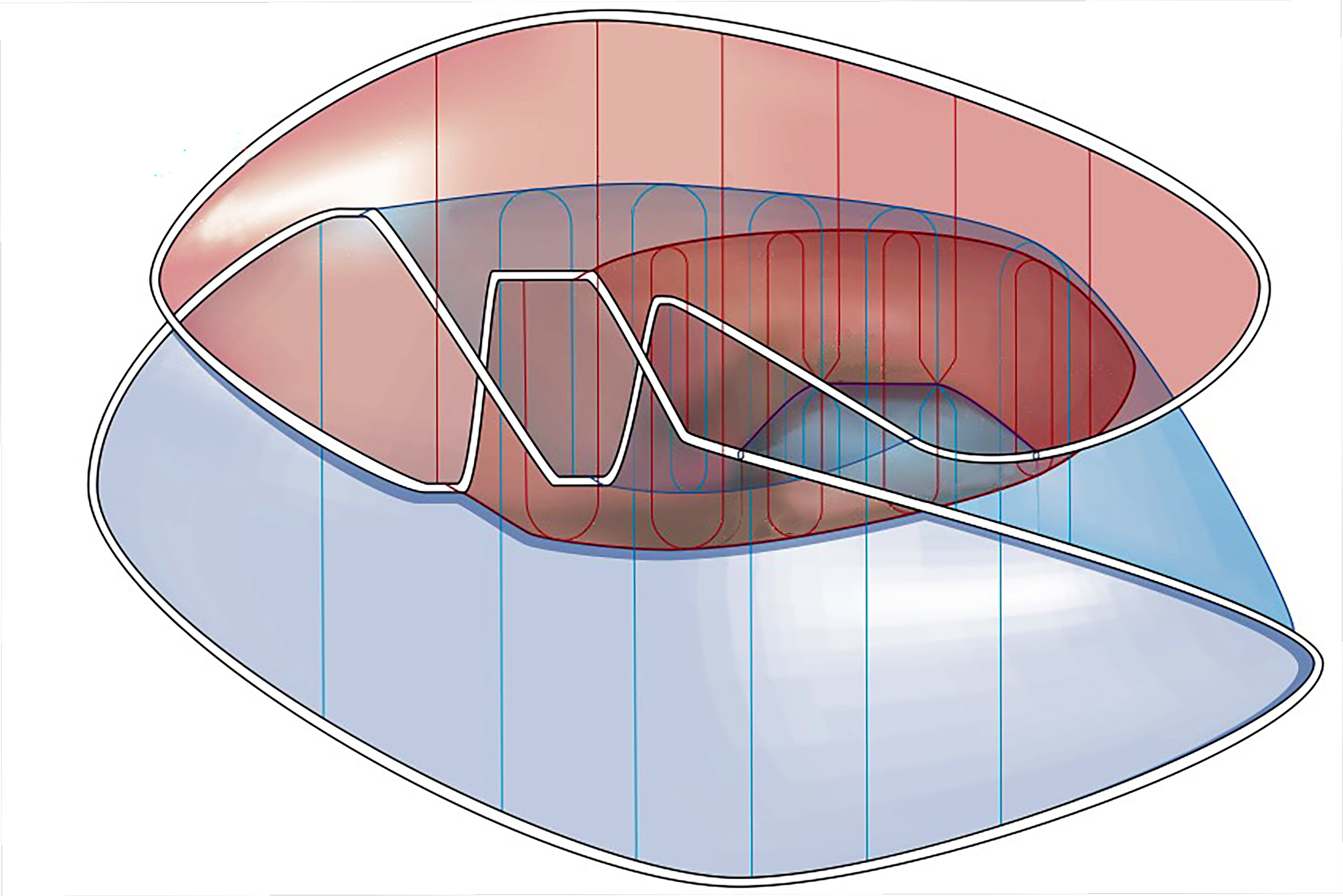
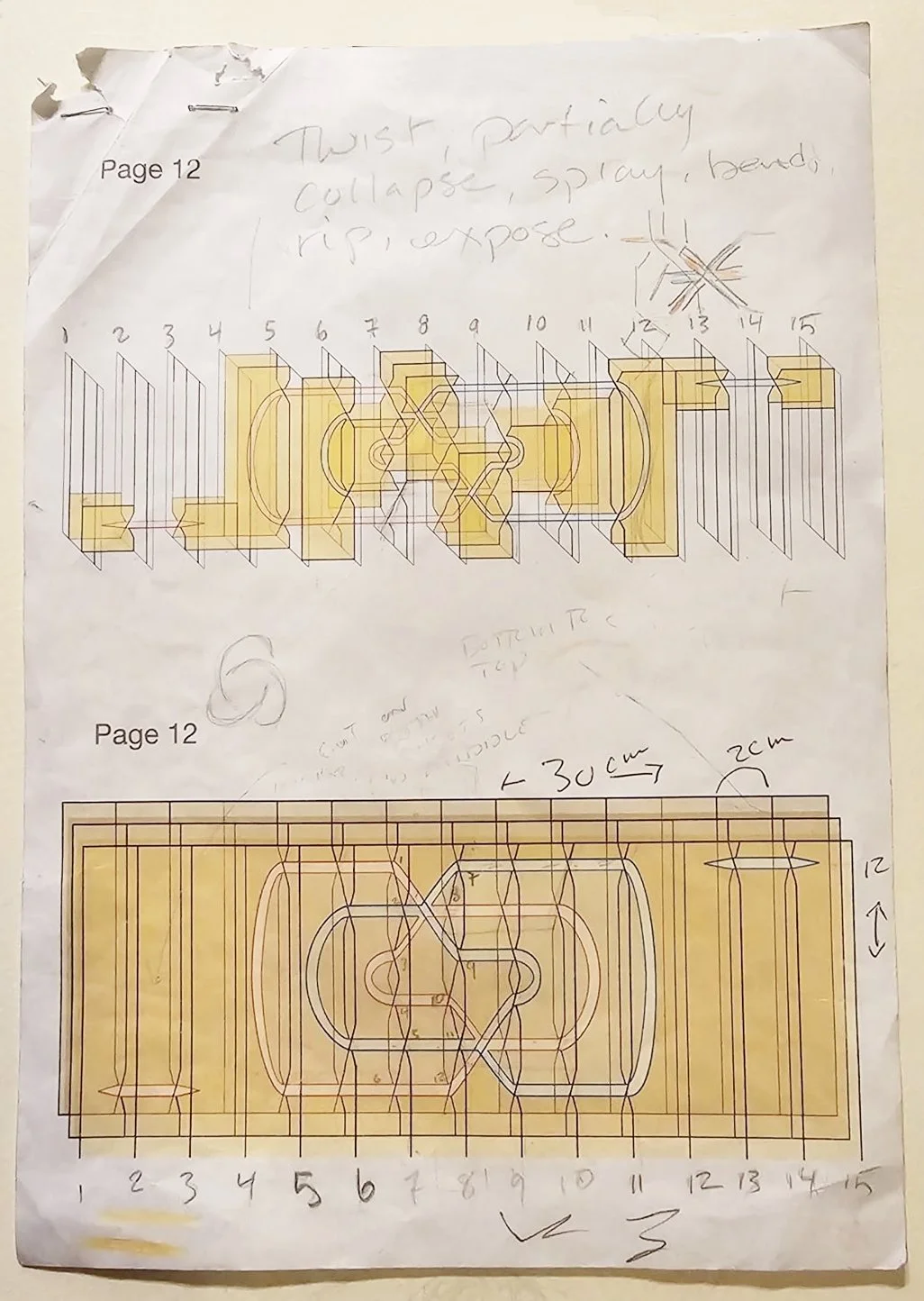
Imagine three spheres nested one inside the other. Make them transparent so you will be able to see their inner workings. Now imagine that in just one defined area they are braided together, undulating back and forth. Deep inside this movement lays an ephemeral trefoil knot. How does the mathematician describe this? With diagrams, starting with the yellow “radiators”. How does an artist describe it? Well, it is an ongoing challenge! I began by deconstructing the diagram on page 12.
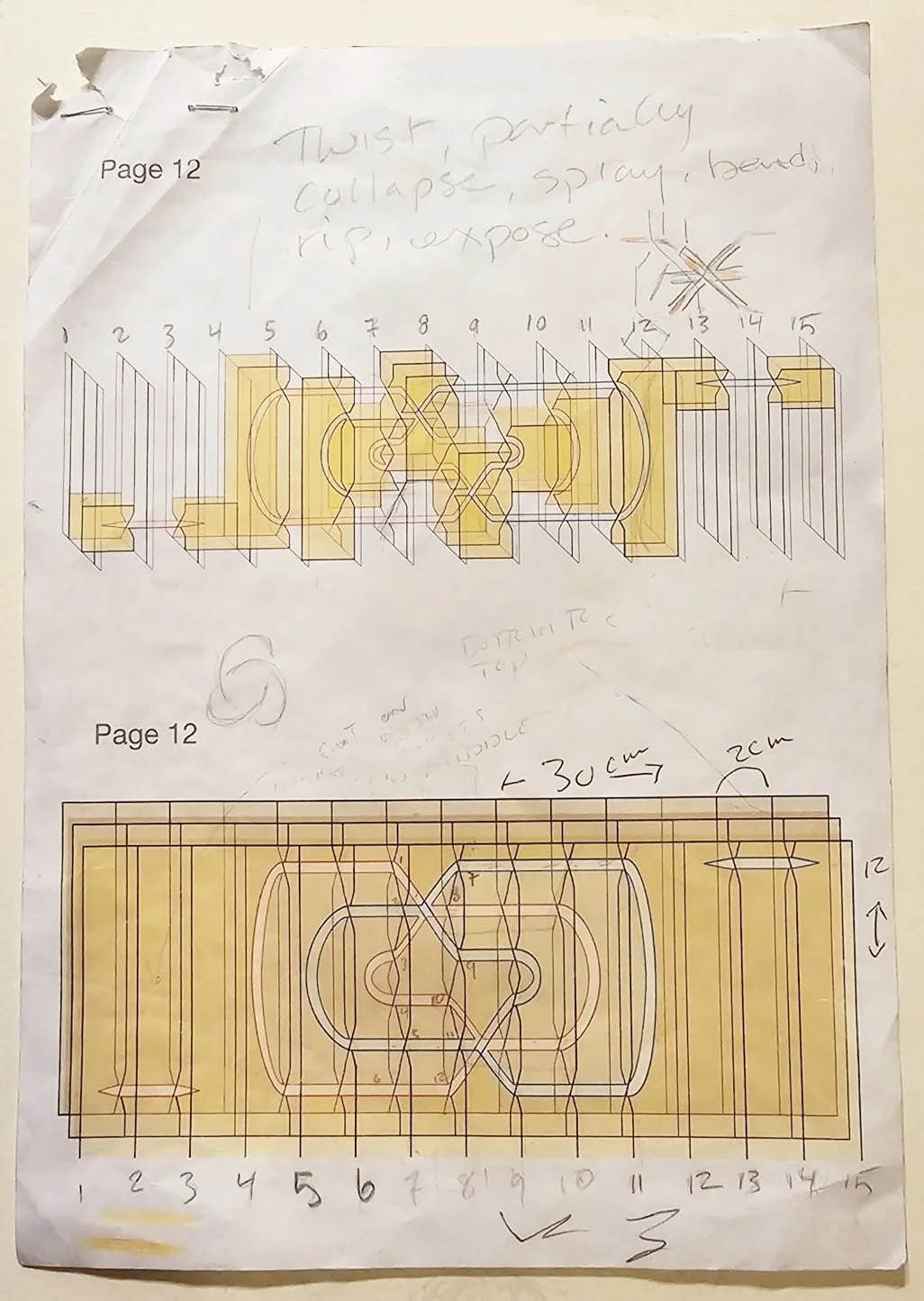
This is page 12 of 17 of the 3-fold branched cover of the 3-sphere branched over the trefoil knot. The yellow rectangles radiators are flattened sections of the three nested spheres. There are three layers representing the rectangular section of each of the three spheres. The vertical lines describe the movement of the surfaces of the spheres. The white lines are where the surfaces meet in 4-space and where traces of the trefoil knot can be found. It is all a bit mind boggling.
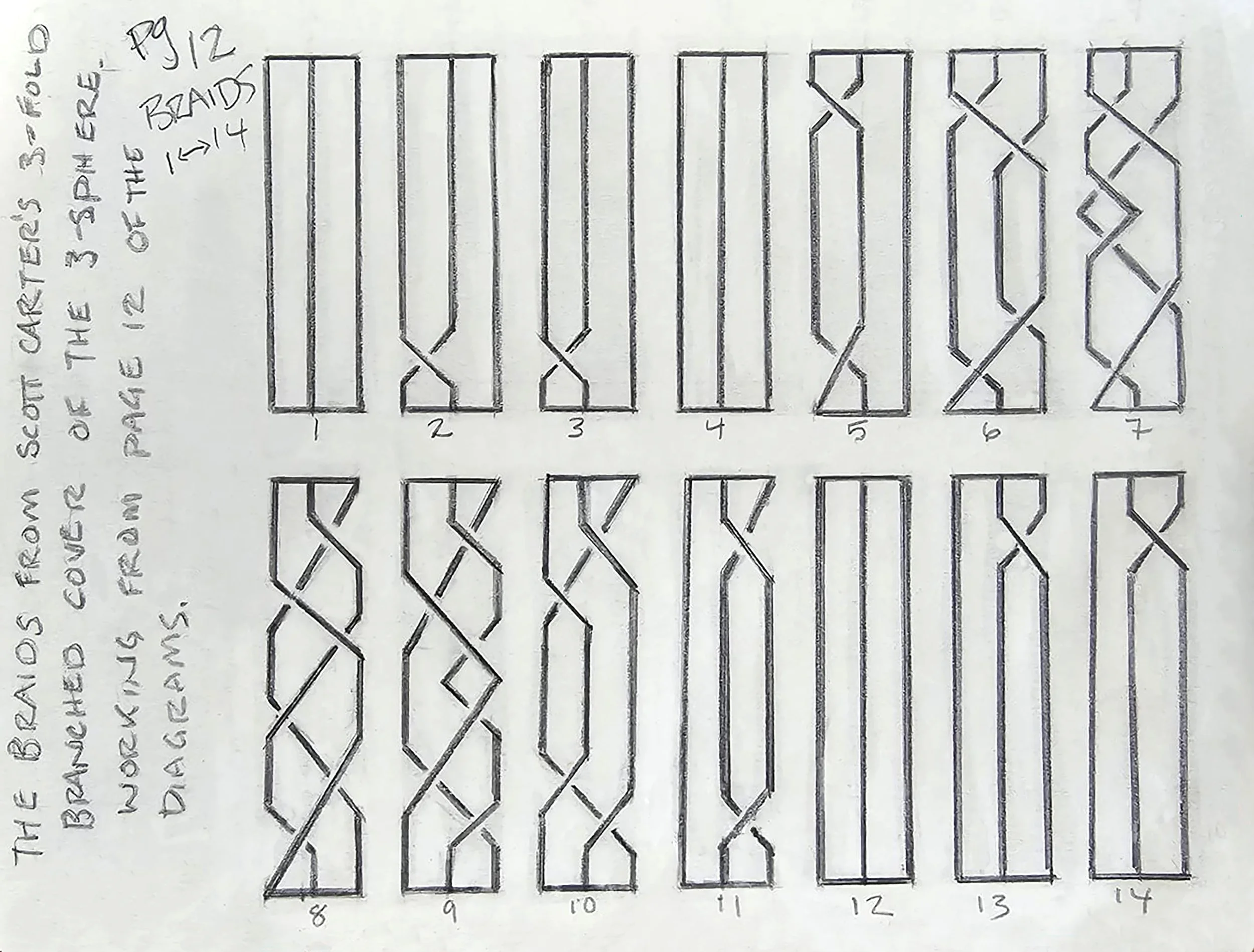
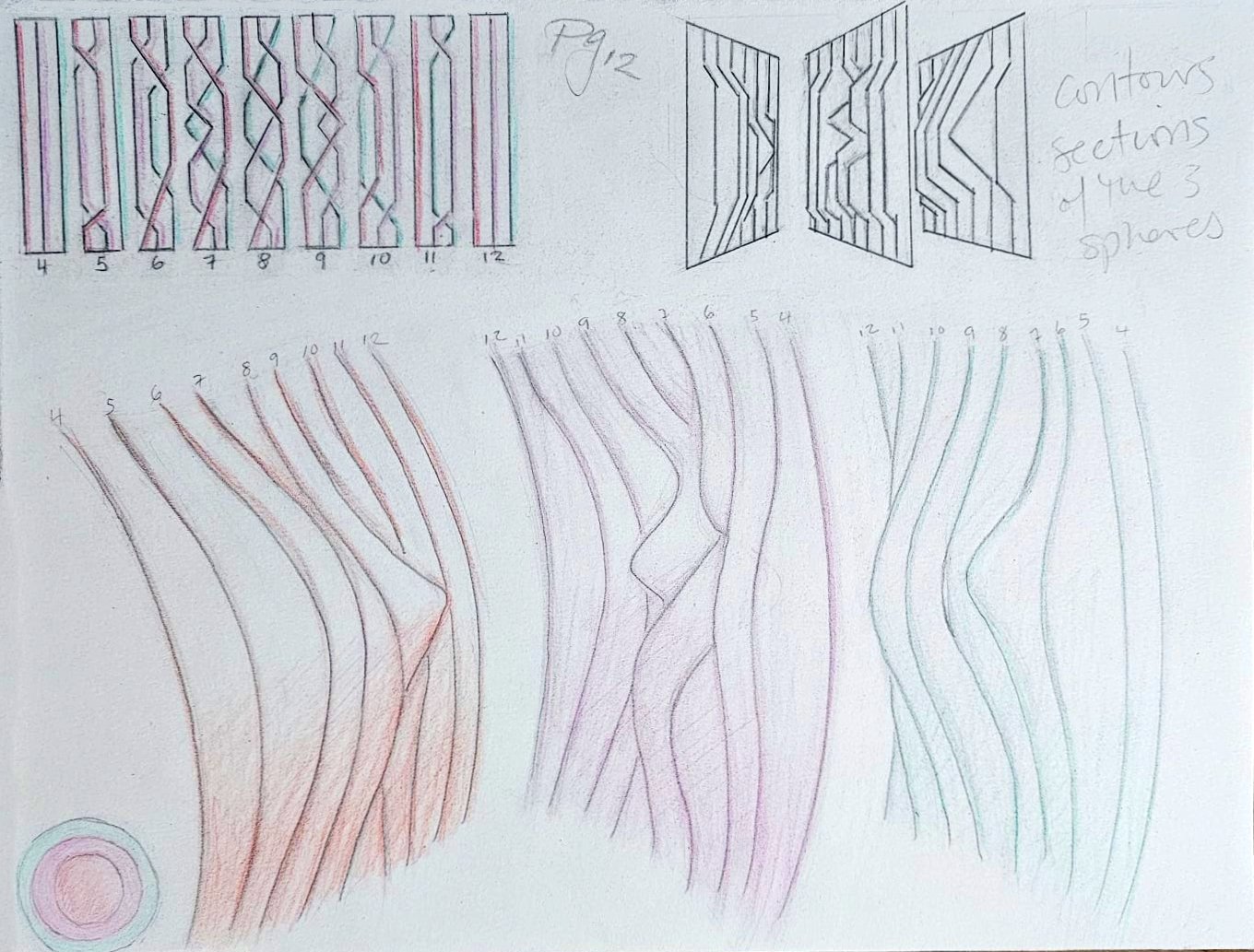
My first task was to make a clear diagram of the braid sets. Each three strands in a set represent the inner, middle and outer spheres reading from left to right. Stack the braid sets horizontally and you have a radiator.
Displayed along side From Diagram to Disorder in the exhibition are the10 support sketches below showing the gradual development toward the main drawing. As a guide for the visitors to the exhibition, they are numbered as they are in the exhibition
1
I began by dismantling the braids, pulling them apart to see the movement of the sphere sections. I wanted a literal translation of what was happening.
2
Here I wanted to restore or create some of the curvature of the spheres at the same time giving a sense of fluidity.
3
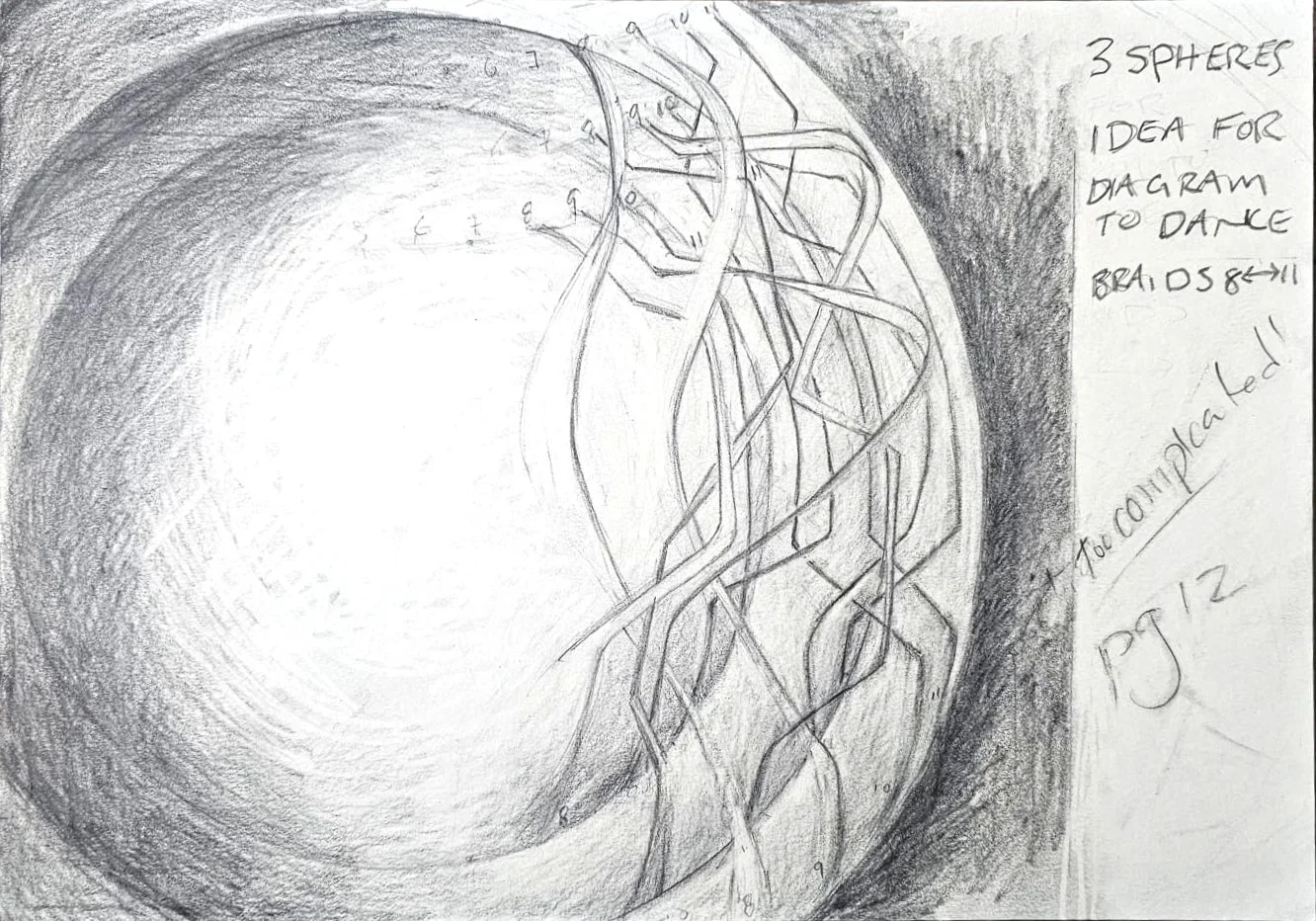
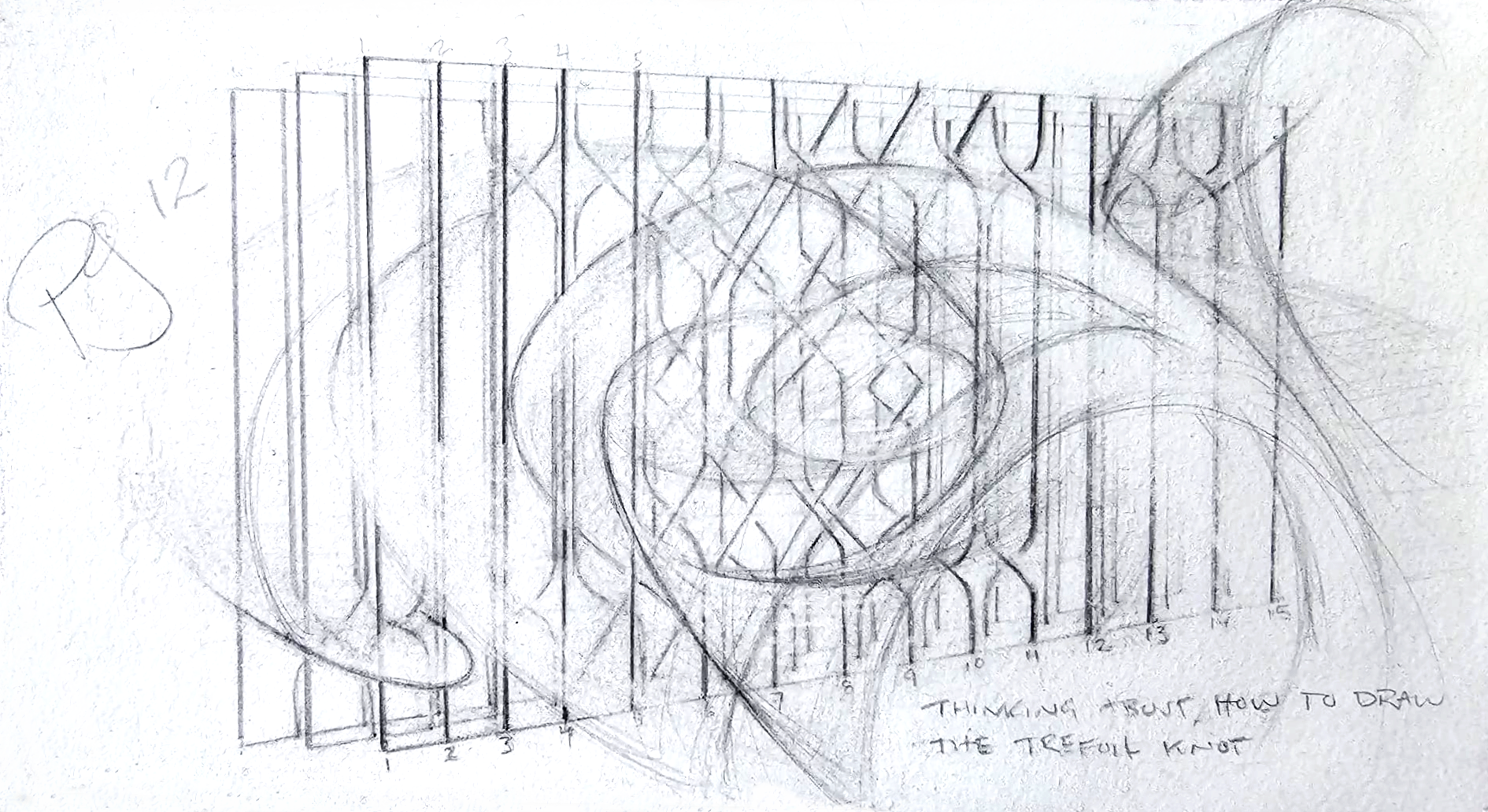
I was trying to find a way to describe the interlacing of the spheres without completely abandoning the diagram. It proved to be a visual jungle and far too complicated.
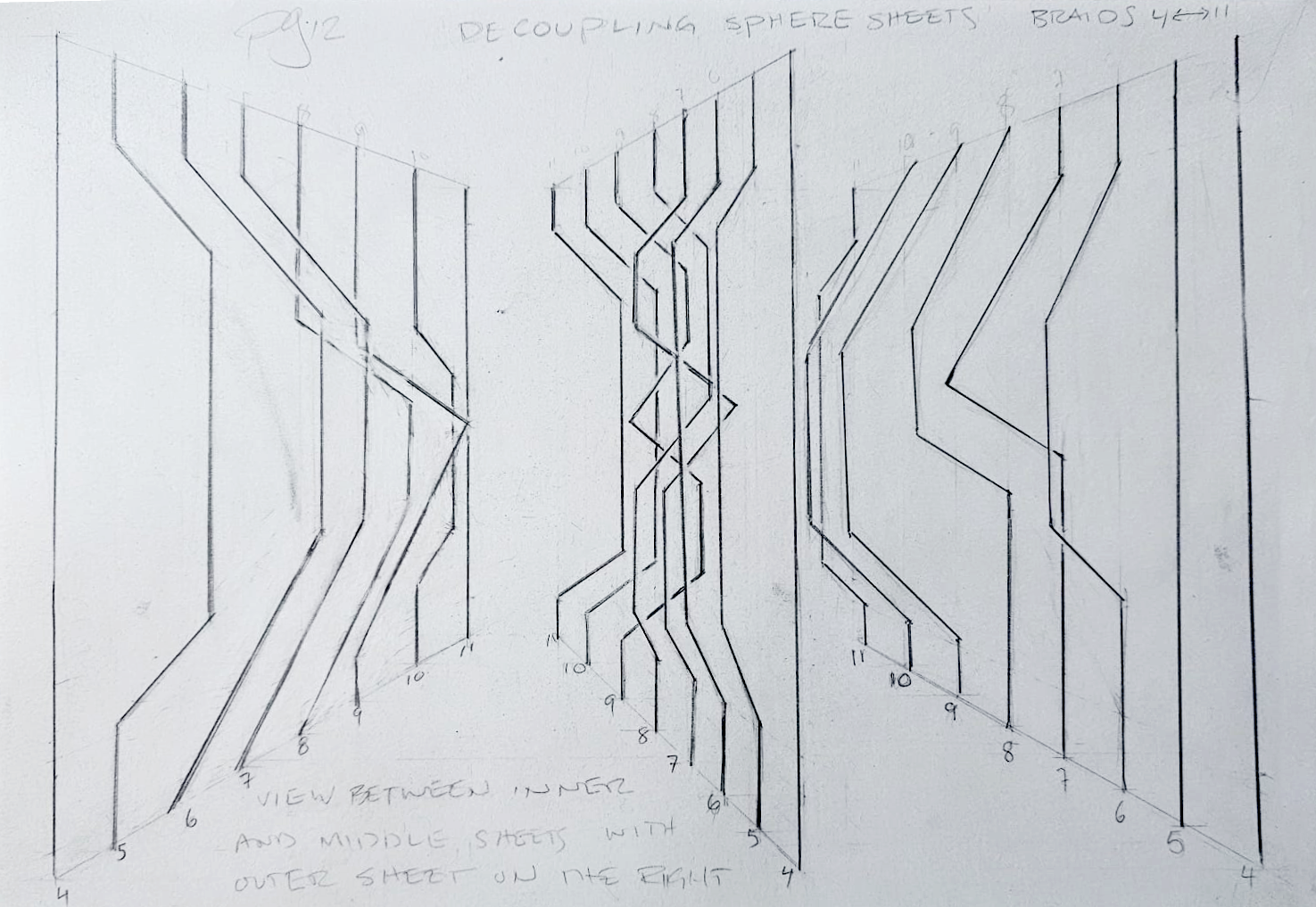
4
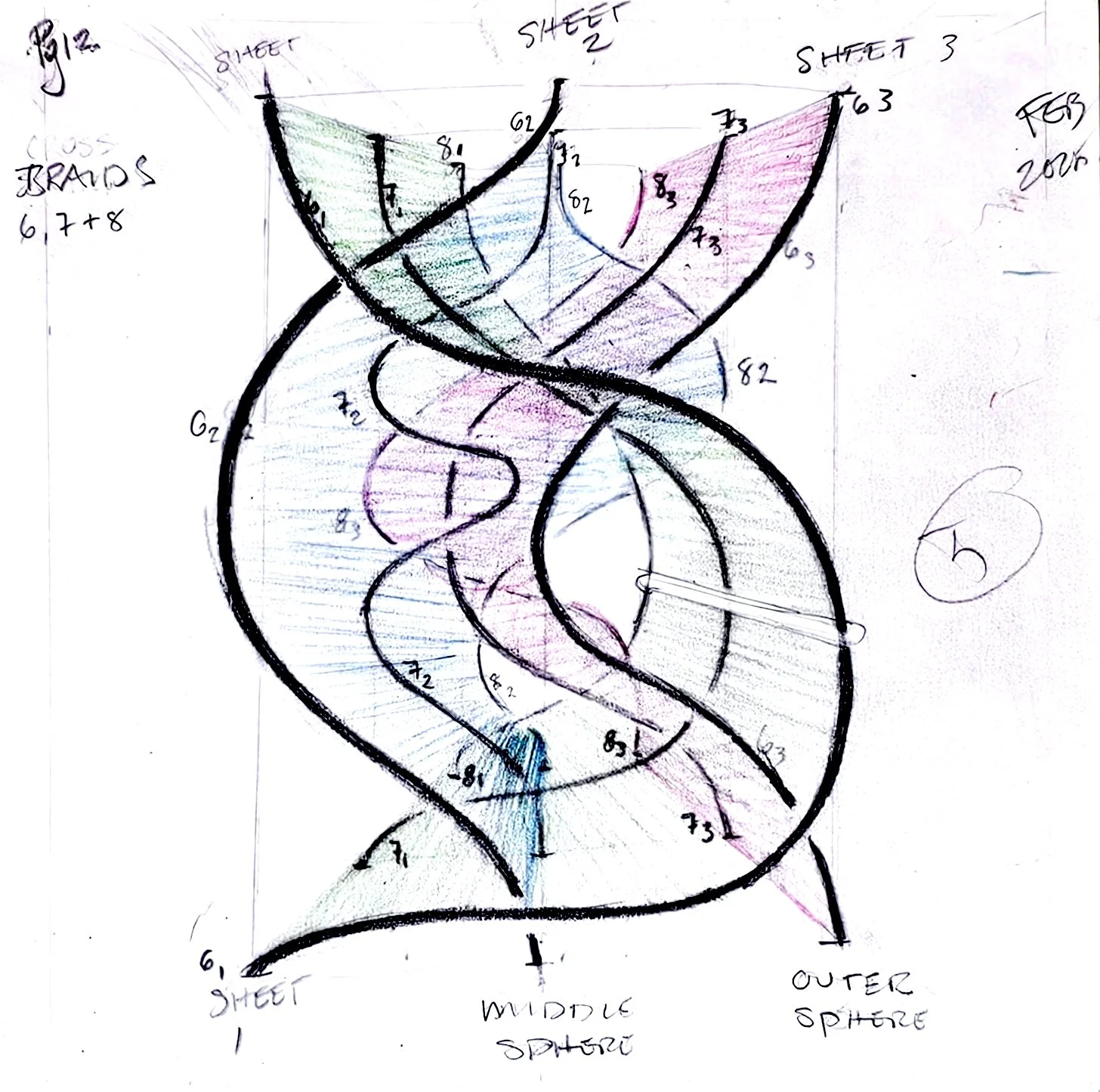
This is one of many, many attempts to view the entangled sphere sections as if looking down the centre section. I could achieve only three braid sets deep before it became unreadable.
5a
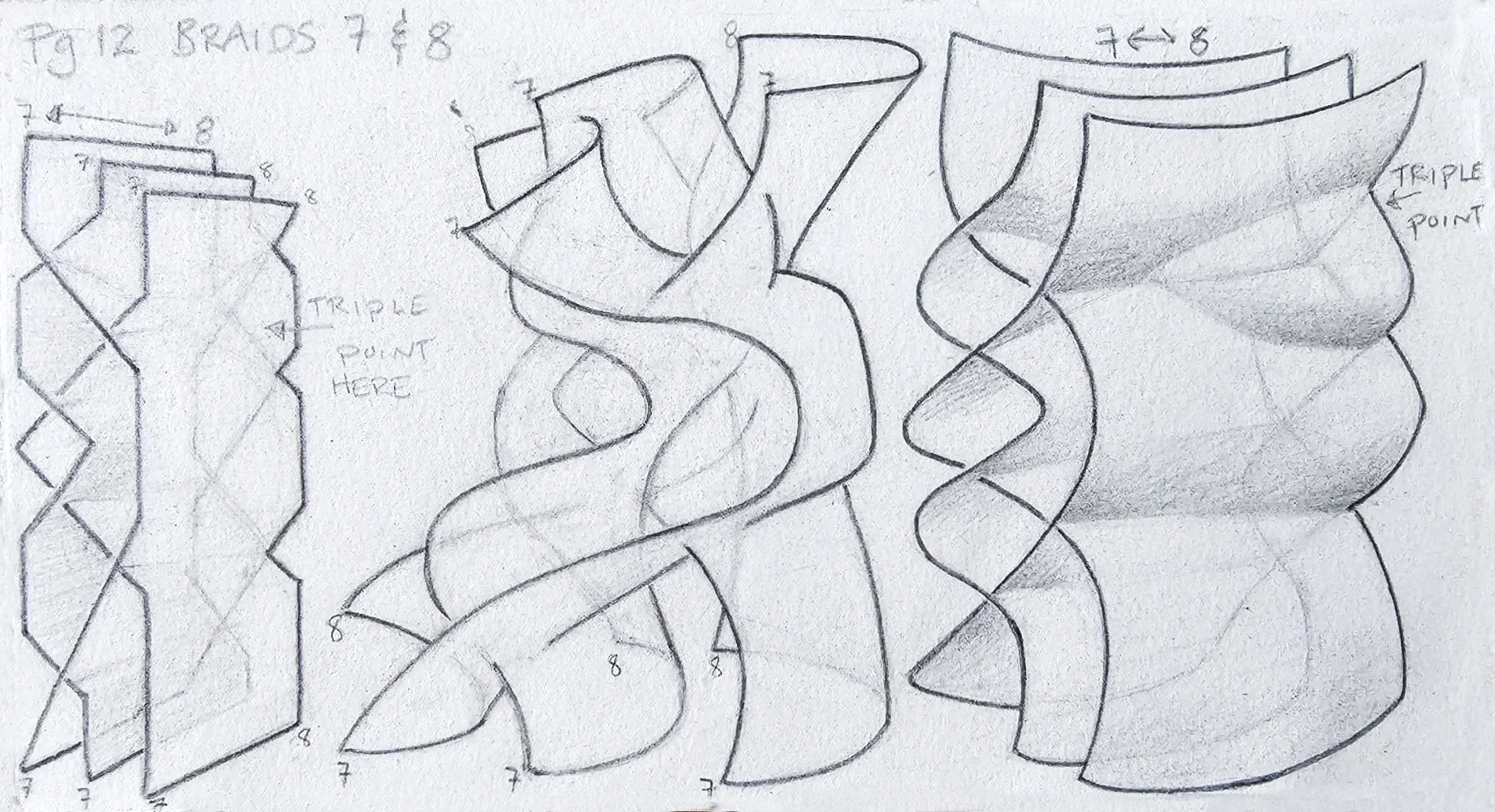
This little sketch shows three ways to describe the surfaces of the spheres between two braid sets. The left-hand one is the standard way taught to me by Scott. The centre is an abstraction and the right-hand one has lost its geometric folds.
5b
I was beginning to grasp what is within the braided structures that allows for the trefoil knot. Here is a sketch of the tentative understanding.
6
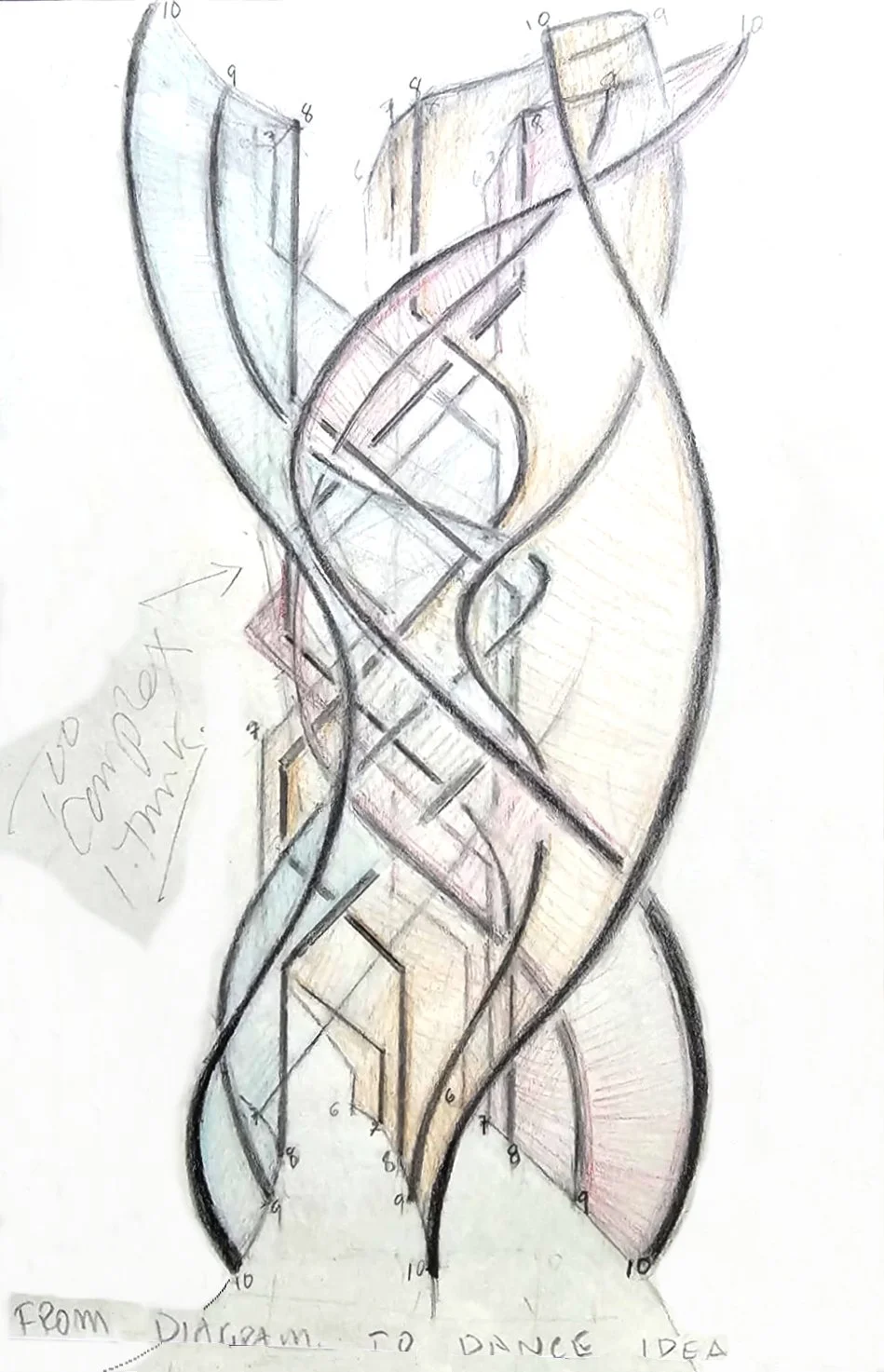
This sketch was another attempt at showing how the spheres braid viewed along their curved surfaces. My aim was to have the angular braid lines slowly lose their sharp angles and become sensuous. Again, I ran into the problem of too much overlay of lines.
7
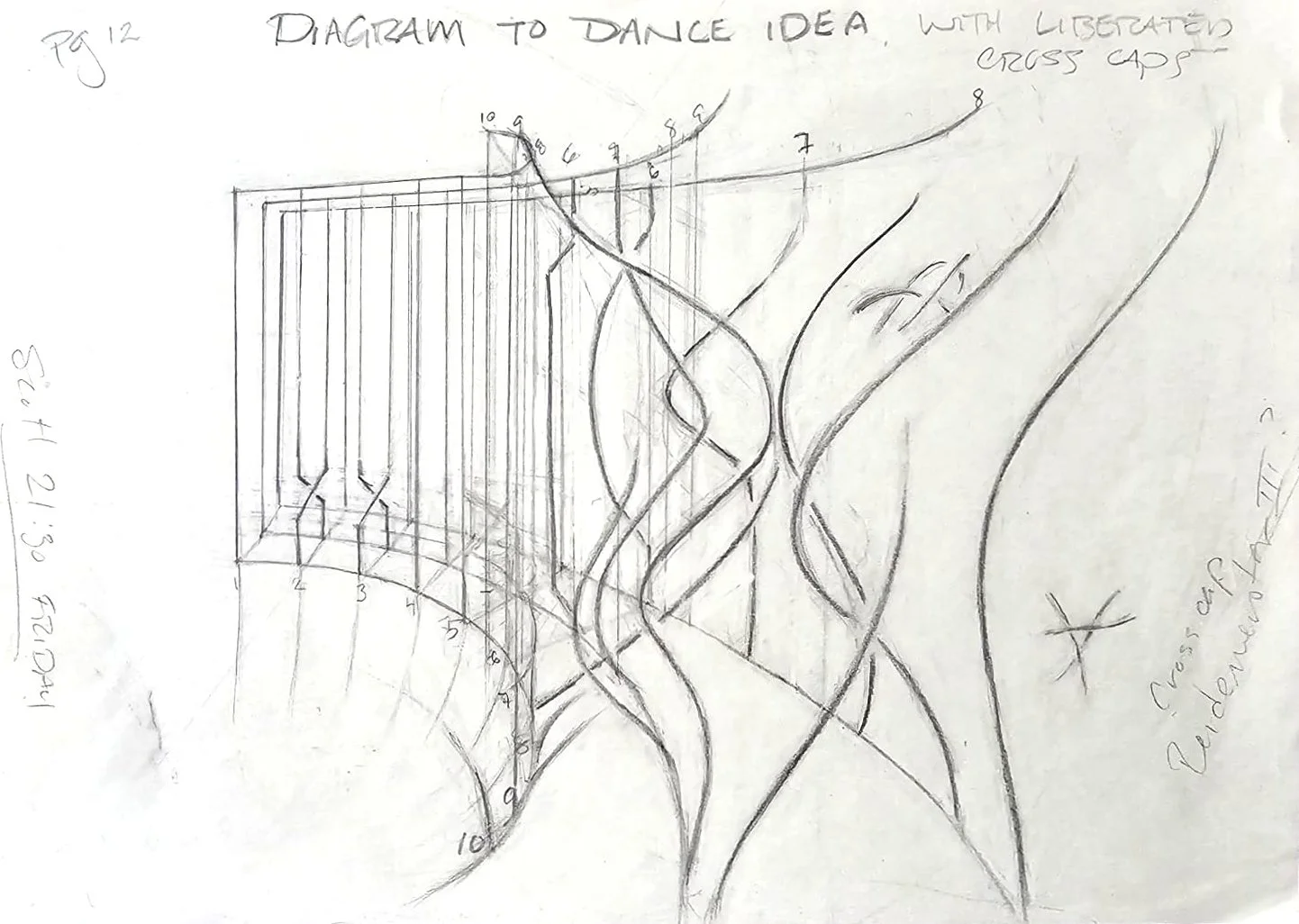
Here I skewed the point of view so that the braid lines had space to stretch along the curvature making them easier to read. But this time I found I could go only so far before the lines became chaotic. I made several attempts to achieve a controlled progression to a dance-like grace.
8
I decided to embrace the disorder. This large drawing was intended to be a finished piece called Diagram to Dance. I wanted to allow some disorder, but I could not control the chaos as I wished. I abandoned the piece.
10
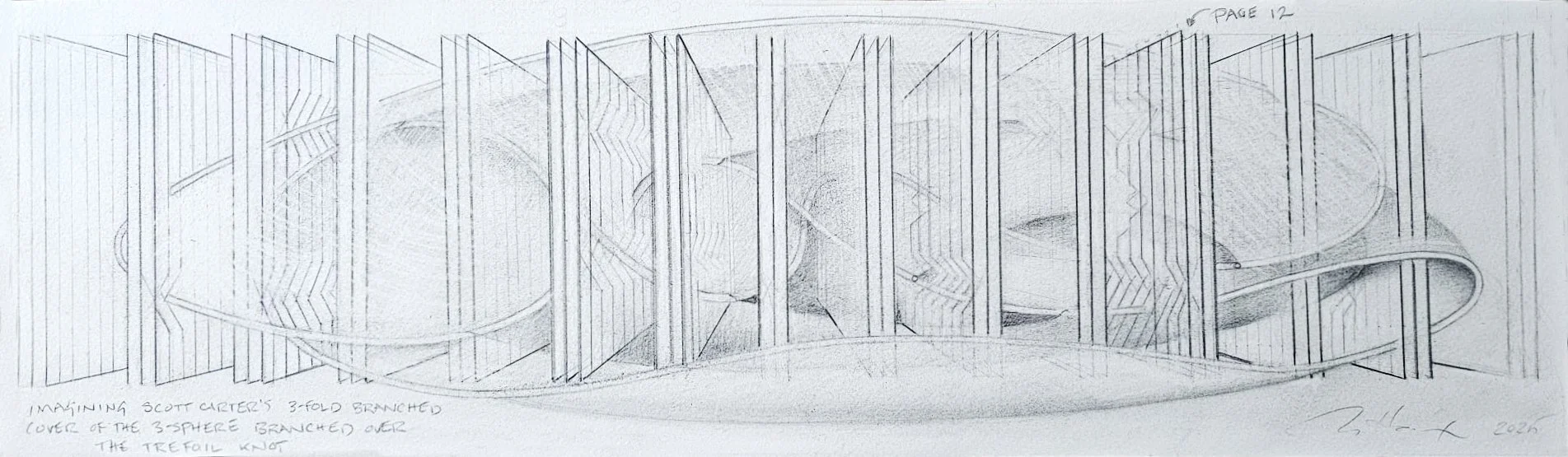
While working on From Diagram to Disorder, Scott and I continued to Zoom. I began to get a better grasp of what generated the trefoil knot and to understand where the illusive knot was hiding. This drawing shows the radiators aligned, each representing a slice of time in the progressive braiding of the three nested spheres. Yes, it is bizarre and perplexing. The trefoil knot is revealed only where it attaches delicately to a few chosen spots in the braiding at given moments in the folding process. It is depicted here as an entity with some substance in order to demonstrate the concept. My next challenge is to capture its illusive existence. Scott tells me that in order to do so I will have to chase it in 5-space.
9
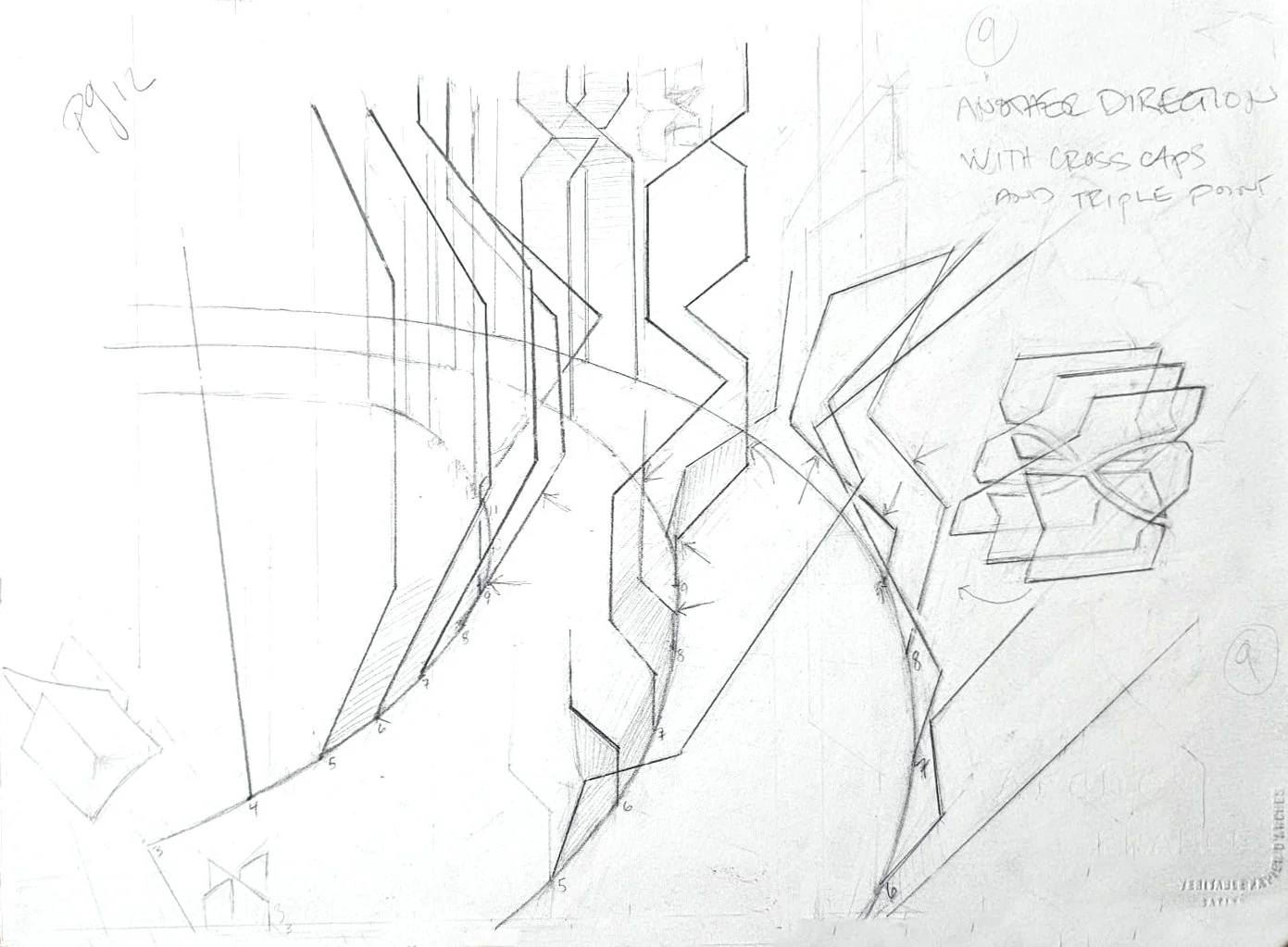
Not to be deterred, I started in another direction. If disorder was to take place it would have to be reigned in. This sketch gave me the impetus to begin From Diagram to Disorder. The previous sensuous, undulating surfaces were too free. I found the discipline of the angularity more restraining, giving me something to work against. And the idea of unfolding the diagram intrigued me. The same disorder pushed back, but in From Diagram to Disorder I had more in control of it. It was a challenge and a joy to have the active push and pull of creativity.